getting quality software from independent makers is like getting quality food from the farmer’s market a jar of handmade organic jam is not the same as mass-produced corn syrup laden jam from the supermarket View Tweet
-
the checklist version of the @obsdmd manifesto:
- free for personal use
- interoperable local plain text files
- no telemetry
- E2E encryption
- flexible API for desktop and mobile
- actively maintained/patched
no VC funding View Tweet
@samcook_ @obsdmd one day you will be walking somewhere wearing your Obsidian pin, and you’ll see someone else wearing a pin, and you’ll nod to each other knowingly, perhaps exchange ideas, and in that moment you will become connected like two nodes in a graph View Tweet
-
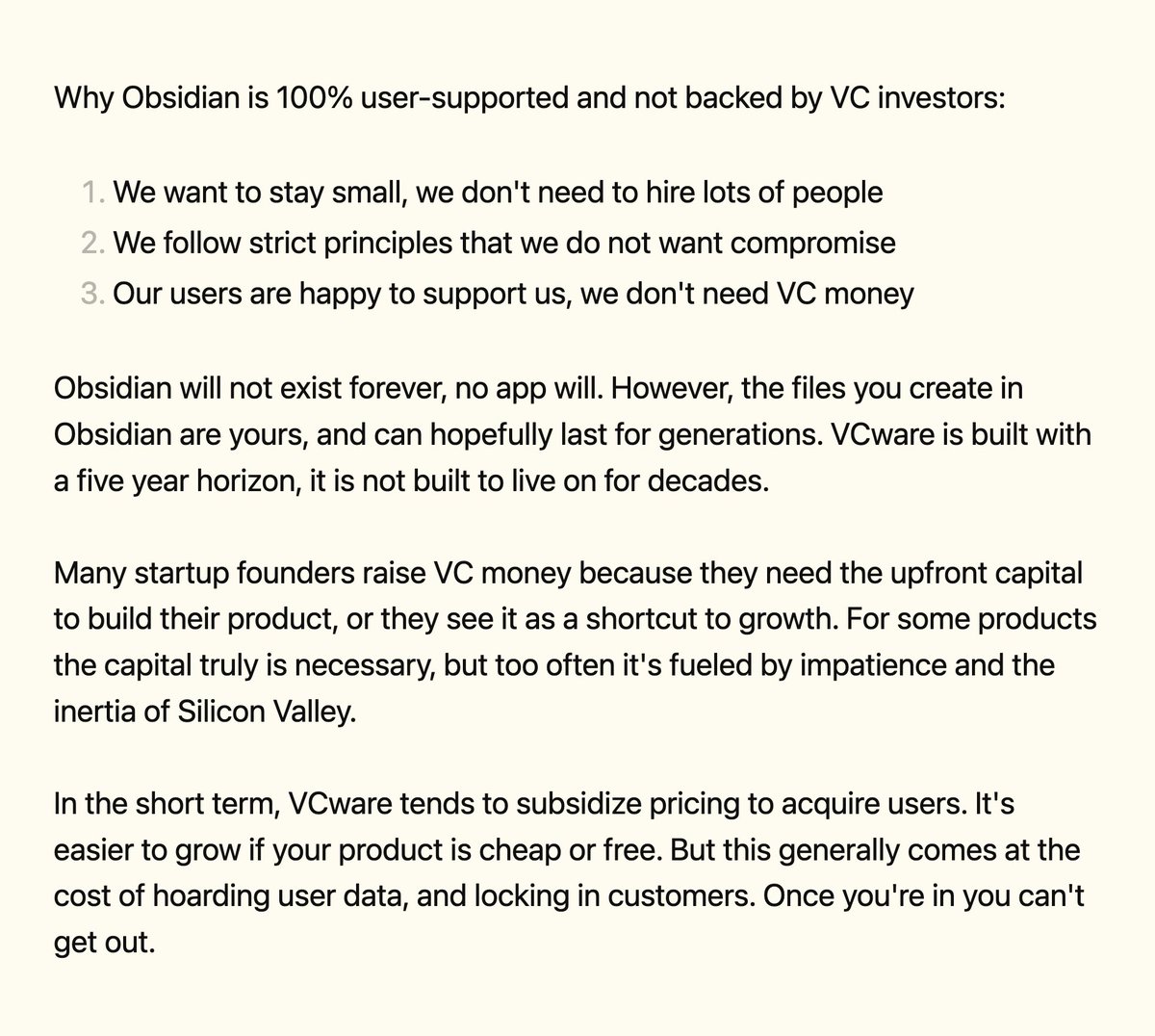
Why @obsdmd is 100% user-supported and not backed by VC investors:
- We want to stay small, we don’t need to hire lots of people
- We follow strict principles that we do not want compromise
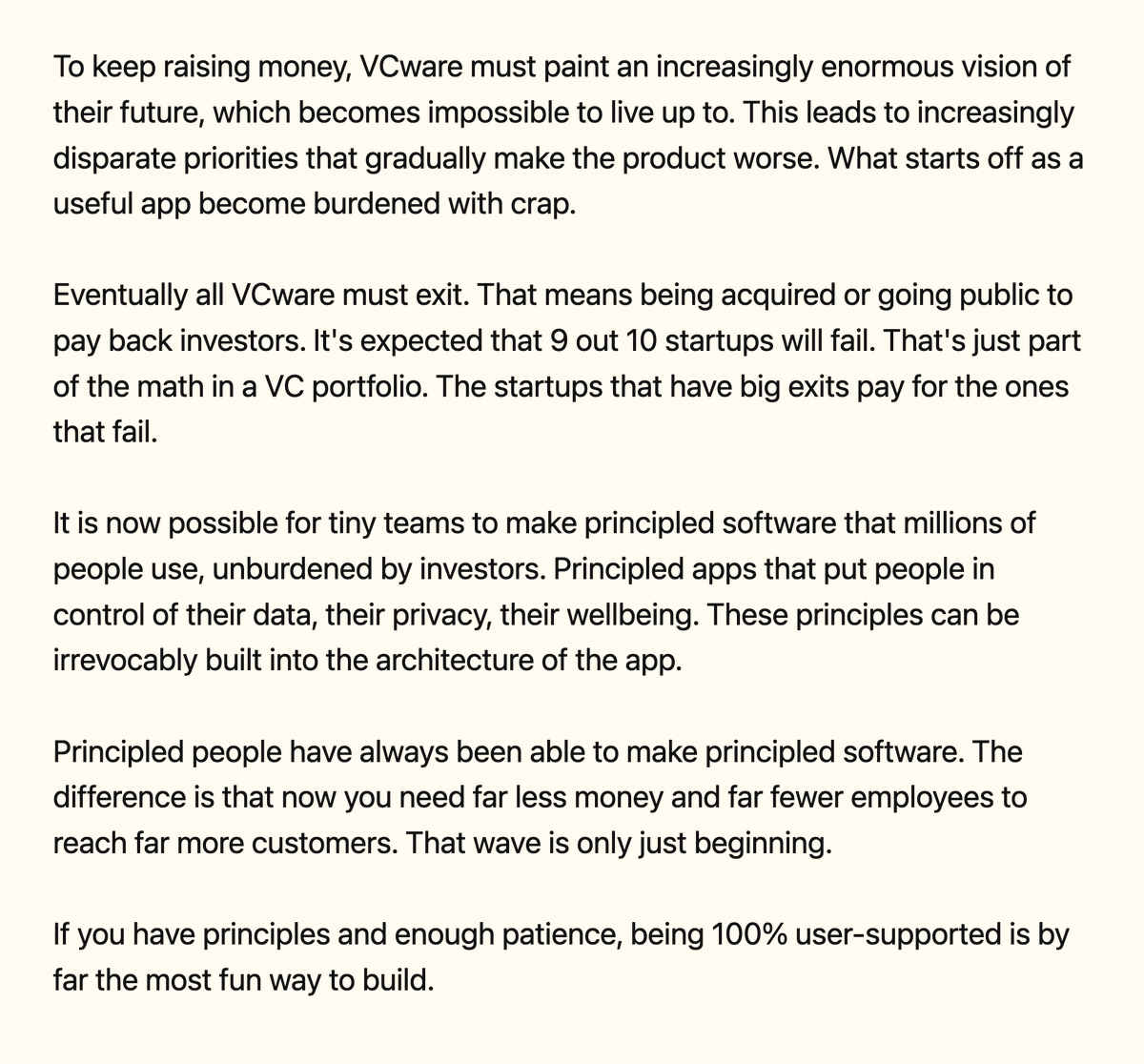
Our users are happy to support us, we don’t need VC money Obsidian will not exist forever, no app will. However, the files you create in Obsidian are yours, and can hopefully last for generations. VCware is built with a five year horizon, it is not built to live on for decades. Many startup founders raise VC money because they need the upfront capital to build their product, or they see it as a shortcut to growth. For some products the capital truly is necessary, but too often it’s fueled by impatience and the inertia of Silicon Valley. In the short term, VCware tends to subsidize pricing to acquire users. It’s easier to grow if your product is cheap or free. But this generally comes at the cost of hoarding user data, and locking in customers. Once you’re in you can’t get out. To keep raising money, VCware must paint an increasingly enormous vision of their future, which becomes impossible to live up to. This leads to increasingly disparate priorities that gradually make the product worse. What starts off as a useful app become burdened with crap. Eventually all VCware must exit. That means being acquired or going public to pay back investors. It’s expected that 9 out 10 startups will fail. That’s just part of the math in a VC portfolio. The startups that have big exits pay for the ones that fail. It is now possible for tiny teams to make principled software that millions of people use, unburdened by investors. Principled apps that put people in control of their data, their privacy, their wellbeing. These principles can be irrevocably built into the architecture of the app. Principled people have always been able to make principled software. The difference is that now you need far less money and far fewer employees to reach far more customers. That wave is only just beginning. If you have principles and enough patience, being 100% user-supported is by far the most fun way to build.
 View Tweet