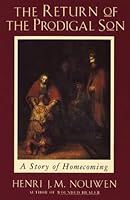
Rembrandt’s embrace remained imprinted on my soul far more profoundly than any temporary expression of emotional support. It had brought me into touch with something within me that lies far beyond the ups and downs of a busy life, something that represents the ongoing yearning of the human spirit, the yearning for a final return, an unambiguous sense of safety, a lasting home.
in. But giving up the somewhat safe position of the critical observer seemed like a great leap into totally unknown territory. I so much wanted to keep some control over my spiritual journey, to remain able to predict at least a part of the outcome, that relinquishing the security of the observer for the vulnerability of the returning son seemed close to impossible.
When Luke writes, “and left for a distant country,” he indicates much more than the desire of a young man to see more of the world. He speaks about a drastic cutting loose from the way of living, thinking, and acting that has been handed down to him from generation to generation as a sacred legacy. More than disrespect, it is a betrayal of the treasured values of family and community. The “distant country” is the world in which everything considered holy at home is disregarded.
It is the never-interrupted voice of love speaking from eternity and giving life and love whenever it is heard. When I hear that voice, I know that I am home with God and have nothing to fear. As the Beloved of my heavenly Father, “I can walk in the valley of darkness: no evil would I fear.” As the Beloved, I can “cure the sick, raise the dead, cleanse the lepers, cast out devils.” Having “received without charge,” I can “give without charge.” As the Beloved, I can confront, console, admonish, and encourage without fear of rejection or need for affirmation. As the Beloved, I can suffer persecution without desire for revenge and receive praise without using it as a proof of my goodness.
Faith is the radical trust that home has always been there and always will be there.
But there are many other voices, voices that are loud, full of promises and very seductive. These voices say, “Go out and prove that you are worth something.” Soon after Jesus had heard the voice calling him the Beloved, he was led to the desert to hear those other voices. They told him to prove that he was worth love in being successful, popular, and powerful.
They suggest that I am not going to be loved without my having earned it through determined efforts and hard work. They want me to prove to myself and others that I am worth being loved, and they keep pushing me to do everything possible to gain acceptance. They deny loudly that love is a totally free gift. I leave home every time I lose faith in the voice that calls me the Beloved and follow the voices that offer a great variety of ways to win the love I so much desire.
And they say: “Show me that you are a good boy. You had better be better than your friend! How are your grades? Be sure you can make it through school! I sure hope you are going to make it on your own!
But when I forget that voice of the first unconditional love, then these innocent suggestions can easily start dominating my life and pull me into the “distant country.” It is not very hard for me to know when this is happening. Anger, resentment, jealousy, desire for revenge, lust, greed, antagonisms, and rivalries are the obvious signs that I have left home.
The proliferation of AI-generated guidance makes it harder to distinguish between an authentic sense of calling and the optimization loops that technology encourages. When competing voices multiply — each offering a path to purpose — the difficulty is no longer finding direction but discerning which direction is not just another form of performance. ecology-of-technologyI am so afraid of being disliked, blamed, put aside, passed over, ignored, persecuted, and killed, that I am constantly developing strategies to defend myself and thereby assure myself of the love I think I need and deserve. And in so doing I move far away from my father’s home and choose to dwell in a “distant country.”
As long as I keep running about asking: “Do you love me? Do you really love me?” I give all power to the voices of the world and put myself in bondage because the world is filled with “ifs.” The world says: “Yes, I love you if you are good-looking, intelligent, and wealthy. I love you if you have a good education, a good job, and good connections. I love you if you produce much, sell much, and buy much.” There are endless “ifs” hidden in the world’s love. These “ifs” enslave me, since it is impossible to respond adequately to all of them. The world’s love is and always will be conditional. As long as I keep looking for my true self in the world of conditional love, I will remain “hooked” to the world—trying, failing, and trying again. It is a world that fosters addictions because what it offers cannot satisfy the deepest craving of my heart.
Knowledge tools promise to answer the conditional “ifs” — if you are smart enough, productive enough, connected enough. But answering all the conditions does not necessarily resolve the deeper question of why. People write from the depths of their experience without expecting those words to be instrumentalized. When a retrieval system surfaces those words as answers to future questions, it raises the question: does having answers make a person feel more worthy, or just more optimized? ecology-of-technologyI am the prodigal son every time I search for unconditional love where it cannot be found. Why do I keep ignoring the place of true love and persist in looking for it elsewhere? Why do I keep leaving home where I am called a child of God, the Beloved of my Father? I am constantly surprised at how I keep taking the gifts God has given me—my health, my intellectual and emotional gifts—and keep using them to impress people, receive affirmation and praise, and compete for rewards, instead of developing them for the glory of God. Yes, I often carry them off to a “distant country” and put them in the service of an exploiting world that does not know their true value.
Here the mystery of my life is unveiled. I am loved so much that I am left free to leave home. The blessing is there from the beginning. I have left it and keep on leaving it.
Caught in this tangle of needs and wants, I no longer know my own motivations. I feel victimized by my surroundings and distrustful of what others are doing or saying. Always on my guard, I lose my inner freedom and start dividing the world into those who are for me and those who are against me. I wonder if anyone really cares. I start looking for validations of my distrust. And wherever I go, I see them, and I say: “No one can be trusted.” And then I wonder whether anyone ever really loved me.
But when God created man and woman in his own image, he saw that “it was very good,” and, despite the dark voices, no man or woman can ever change that. The choice for my own sonship, however, is not an easy one. The dark voices of my surrounding world try to persuade me that I am no good and that I can only become good by earning my goodness through “making it” up the ladder of success.
I am amazed by the emotional energy that goes into these inner ruminations and murmurings. Yes, I am leaving the foreign country. Yes, I am going home … but why all this preparation of speeches which will never be delivered? The reason is clear. Although claiming my true identity as a child of God, I still live as though the God to whom I am returning demands an explanation. I still think about his love as conditional and about home as a place I am not yet fully sure of. While walking home, I keep entertaining doubts about whether I will be truly welcome when I get there.
It is a self-serving repentance that offers the possibility of survival. I know this state of mind and heart quite well. It is like saying: “Well, I couldn’t make it on my own, I have to acknowledge that God is the only resource left to me. I will go to God and ask for forgiveness in the hope that I will receive a minimal punishment and be allowed to survive on the condition of hard labor.” God remains a harsh, judgmental God. It is this God who makes me feel guilty and worried and calls up in me all these self-serving apologies. Submission to this God does not create true inner freedom, but breeds only bitterness and resentment. One of the greatest challenges of the spiritual life is to receive God’s forgiveness.
Sometimes it even seems as though I want to prove to God that my darkness is too great to overcome. While God wants to restore me to the full dignity of sonship, I keep insisting that I will settle for being a hired servant. But do I truly want to be restored to the full responsibility of the son? Do I truly want to be so totally forgiven that a completely new way of living becomes possible?
Receiving forgiveness requires a total willingness to let God be God and do all the healing, restoring, and renewing. As long as I want to do even a part of that myself, I end up with partial solutions, such as becoming a hired servant.
The theological claim here — that healing requires relinquishing control to something beyond the self — sits uncomfortably with language models designed to do a user’s bidding. An LLM that reflects back only what is asked of it cannot play the role of an authority that restores on its own terms. The tool is structurally incapable of the asymmetry that forgiveness requires. ecology-of-technology captureHow can those who have come to this second childhood, this second innocence, be described? Jesus does this very clearly in the Beatitudes. Shortly after hearing the voice calling him the Beloved, and soon after rejecting Satan’s voice daring him to prove to the world that he is worth being loved, he begins his public ministry. One of his first steps is to call disciples to follow him and share in his ministry. Then Jesus goes up onto the mountain, gathers his disciples around him, and says: “How blessed are the poor, the gentle, those who mourn, those who hunger and thirst for uprightness, the merciful, the pure of heart, the peacemakers, and those who are persecuted in the cause of uprightness.”
Isn’t he the sinless Son of God who cried out on the cross: “My God, my God, why have you forsaken me?” Jesus is the prodigal son of the prodigal Father who gave away everything the Father had entrusted to him so that I could become like him and return with him to his Father’s home.
even his body and his blood; after having felt deeply in himself sadness, anguish, and a troubled soul; after having gone to the bottom of despair, with which he voluntarily dressed himself as being abandoned by his Father far away from the source of living water, he cried out from the cross on which he was nailed: “I am thirsty.”
This Rembrandt is hard to face. It is not so difficult to sympathize with a lustful character who indulges in the hedonistic pleasures of the world, then repents, returns home, and becomes a very spiritual person. But appreciating a man with deep resentments, wasting much of his precious time in rather petty court cases and constantly alienating people by his arrogant behavior, is much harder to do. Yet, to the best of my knowledge, that, too, was a part of his life, a part I cannot ignore.
Both needed the embrace of a forgiving father. But from the story itself, as well as from Rembrandt’s painting, it is clear that the hardest conversion to go through is the conversion of the one who stayed home.
All of this became very real for me when a friend who had recently become a Christian criticized me for not being very prayerful. His criticism made me very angry. I said to myself, “How dare he teach me a lesson about prayer! For years he has lived a carefree and undisciplined life, while I since childhood have scrupulously lived the life of faith. Now he is converted and starts telling me how to behave!” This inner resentment reveals to me my own “lostness.” I had stayed home and didn’t wander off, but I had not yet lived a free life in my father’s house. My anger and envy showed me my own bondage.
The lostness of the resentful “saint” is so hard to reach precisely because it is so closely wedded to the desire to be good and virtuous. I know, from my own life, how diligently I have tried to be good, acceptable, likable, and a worthy example for others. There was always the conscious effort to avoid the pitfalls of sin and the constant fear of giving in to temptation. But with all of that there came a seriousness, a moralistic intensity—and even a touch of fanaticism—that made it increasingly difficult to feel at home in my Father’s house. I became less free, less spontaneous, less playful, and others came to see me more and more as a somewhat “heavy” person.
The more I dwell on the matters in question, the worse my state becomes. The more I analyze it, the more reason I see for complaint. And the more deeply I enter it, the more complicated it gets. There is an enormous, dark drawing power to this inner complaint. Condemnation of others and self-condemnation, self-righteousness and self-rejection keep reinforcing each other in an ever more vicious way.
A complainer is hard to live with, and very few people know how to respond to the complaints made by a self-rejecting person. The tragedy is that, often, the complaint, once expressed, leads to that which is most feared: further rejection. From this perspective, the elder son’s inability to share in the joy of his father becomes quite understandable. When he came home from the fields, he heard music and dancing. He knew there was joy in the household. Immediately, he became suspicious. Once the self-rejecting complaint has formed in us, we lose our spontaneity to the extent that even joy can no longer evoke joy in us.
My resentment is not something that can be easily distinguished and dealt with rationally. It is far more pernicious: something that has attached itself to the underside of my virtue.
“My son, you are with me always, and all I have is yours.”
He understands their highly unique gifts and shortcomings. He sees with love the passion of his younger son, even when it is not regulated by obedience. With the same love, he sees the obedience of the elder son, even when it is not vitalized by passion.
The elder son no longer has a brother. Nor, any longer, a father. Both have become strangers to him. His brother, a sinner, he looks down on with disdain; his father, a slave owner, he looks up at with fear. Here I see how lost the elder son is. He has become a foreigner in his own house.
True communion is gone. Every relationship is pervaded by the darkness. To be afraid or to show disdain, to suffer submission or to enforce control, to be an oppressor or to be a victim: these have become the choices for one outside of the light. Sins cannot be confessed, forgiveness cannot be received, the mutuality of love cannot exist. True communion has become impossible. I know the pain of this predicament. In it, everything loses its spontaneity. Everything becomes suspect, self-conscious, calculated, and full of second-guessing. There is no longer any trust. Each little move calls for a countermove; each little remark begs for analysis; the smallest gesture has to be evaluated. This is the pathology of the darkness.
The return to the “Father from whom all fatherhood takes its name” allows me to let my dad be no less than the good, loving, but limited human being he is, and to let my heavenly Father be the God whose unlimited, unconditional love melts away all resentments and anger and makes me free to love beyond the need to please or find approval.
There is a very strong, dark voice in me that says the opposite: “God isn’t really interested in me, he prefers the repentant sinner who comes home after his wild escapades. He doesn’t pay attention to me who has never left the house. He takes me for granted. I am not his favorite son. I don’t expect him to give me what I really want.” At times this dark voice is so strong that I need enormous spiritual energy to trust that the Father wants me home as much as he does the younger son. It requires a real discipline to step over my chronic complaint and to think, speak, and act with the conviction that I am being sought and will be found. Without such discipline, I become prey to self-perpetuating hopelessness.
To prevail, this trust has to be even deeper than the sense of lostness. Jesus expresses its radicalness when he says: “Everything you ask and pray for, trust that you have it already, and it will be yours.” Living in this radical trust will open the way for God to realize my deepest desire.
Both trust and gratitude require the courage to take risks because distrust and resentment, in their need to keep their claim on me, keep warning me how dangerous it is to let go of my careful calculations and guarded predictions. At many points I have to make a leap of faith to let trust and gratitude have a chance: to write a gentle letter to someone who will not forgive me, make a call to someone who has rejected me, speak a word of healing to someone who cannot do the same.
things. The Father wants to say, more with his touch than with his voice, good things of his children. He has no desire to punish them. They have already been punished excessively by their own inner or outer waywardness. The Father wants simply to let them know that the love they have searched for in such distorted ways has been, is, and always will be there for them. The Father wants to say, more with his hands than with his mouth: “You are my Beloved, on you my favor rests.”
I am beginning now to see how radically the character of my spiritual journey will change when I no longer think of God as hiding out and making it as difficult as possible for me to find him, but, instead, as the one who is looking for me while I am doing the hiding. When I look through God’s eyes at my lost self and discover God’s joy at my coming home, then my life may become less anguished and more trusting. Wouldn’t it be good to increase God’s joy by letting God find me and carry me home and celebrate my return with the angels? Wouldn’t it be wonderful to make God smile by giving God the chance to find me and love me lavishly? Questions like these raise a real issue: that of my own self-concept. Can I accept that I am worth looking for? Do I believe that there is a real desire in God to simply be with me?
— There is a cultural assumption that we don’t have the tools or skills to do what we were put on earth to do, so we must build them. Entrepreneurship runs on this premise. But the idea that God is actively looking for us — rather than hiding — inverts the entire posture: the work is not to build the means of arrival but to stop hiding from what’s already seeking you. entrepreneurshipGod rejoices. Not because the problems of the world have been solved, not because all human pain and suffering have come to an end, nor because thousands of people have been converted and are now praising him for his goodness. No, God rejoices because one of his children who was lost has been found. What I am called to is to enter into that joy. It is God’s joy, not the joy that the world offers. It is the joy that comes from seeing a child walk home amid all the destruction, devastation, and anguish of the world. It is a hidden joy,
The biblical view of individual narrative — that God rejoices over one person’s return, not over scale — reframes what it means for stories to matter. Individual narrative doesn’t have to justify itself by solving the world’s problems. It is sufficient that someone’s particular story is seen and met. This stands in tension with systems that only value stories at aggregate scale. discovery storytellingI have to learn to “steal” all the real joy there is to steal and lift it up for others to see. Yes, I know that not everybody has been converted yet, that there is not yet peace everywhere, that all pain has not yet been taken away, but still, I see people turning and returning home; I hear voices that pray; I notice moments of forgiveness, and I witness many signs of hope. I don’t have to wait until all is well, but I can celebrate every little hint of the Kingdom that is at hand.
People who have come to know the joy of God do not deny the darkness, but they choose not to live in it. They claim that the light that shines in the darkness can be trusted more than the darkness itself and that a little bit of light can dispel a lot of darkness. They point each other to flashes of light here and there, and remind each other that they reveal the hidden but real presence of God.