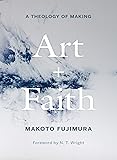
Against those who might see justice and mercy as antithetical, he knows that God’s longing to put the world right (“Justice”) is in fact a crucial aspect of an even deeper characteristic, namely, the divine mercy. This is the point at which we are introduced to the ancient Japanese tradition of Kintsugi, the art of taking broken porcelain—characteristically, items used in serving tea—and, by the golden material used for the repair, making of them something even more beautiful than before. (When Mako writes about gold, we sense the intimacy of the careful workman, as well as the insightful reader of scripture: “Even in Eden,” he writes, “the gold was hidden. We have work to do.”)
“When we make,” writes Fujimura as the book gets under way, “we invoke the abundance of God’s world into the reality of scarcity all about us.” This is true Theology. It explains, too, why “making” in this sense is central, rather than peripheral, to presenting the gospel to an unready world. This book opens a life-giving vista on the beauty and mercy of God, and invites us to join in the feast.
water falling from a faucet; drip by drip, through literature and art, through important relationships, and by creating and making, I felt I was honoring the source of beauty and poetry in the world.
How much water to add, at what temperature, is determined by the type of painting I am working on and what I desire to accomplish. The somatic knowledge gained through years of making has become a way for me to “understand” my own works. And through this act, I begin to feel deeply the compassion of God for my own existence, and by extension for the existence of others. My works, therefore, have a life of their own, and I am listening to the voice of the Creator through my creation. I am drawn into prayer as I work.
When I explain to strangers this sacred dimension of creating art, sometimes non-Christians have an easier time grasping it. Christians have many presuppositions about what Christianity is that are often based upon an analytical approach to understanding truth as a set of propositional beliefs, such that understanding and explaining take dominance over experiencing and intuiting. But that grounding is based less on a biblical, generative path than on the mechanistic, postindustrial thinking of utilitarian pragmatism.2 Imagine trying to explain to a flying bird the aerodynamic forces at work when its wings move. Perhaps explaining it undermines the flight itself; perhaps the effort to understand it will not help the flying at all.
When we make, we invite the abundance of God’s world into the reality of scarcity all about us.
Such intuitive overlaps are hard to explain rationally, and we tend to avoid the emotive, “feelings” side of experience; but as artists, we are trained to trust our intuition, to think through our feelings, and even to distrust our emotions at times to gain access to deeper integrated realities. We artists dare not “understand” or overanalyze our creative acts, just as the bird does not need to understand the aerodynamics of flight. All artists, in this sense, operate out of a faith in abundance and the experience of hope, despite the propensity of our egos to twist all that is good and make idols. If what we are created to do actually allows us to fly beyond the limited capacities of reason and observation, perhaps we will believe that there is abundance at the base of creation and that we can create out of that abundance without having to explain how we access it. We are free to take flight in the grace of its sustaining currents without knowing where the wind comes from.
I often wonder whether the younger “None” generation (meaning they mark “None” when asked on forms whether they belong to any religious denomination or group or espouse a particular creed), for whom the old wineskin of how church is done may no longer seem relevant, is now limited to experiencing God authentically primarily through culture and nature, two areas that evangelicalism in the United States has abandoned in order to “evangelize” the world.
The Danish “home mission” (Indre Mission) tradition prioritized local, nature-embedded faith over the pragmatics of formal education — a naturalistic orientation toward belief that trusted proximity and place over institutional scale.creativity. Nature can be a door to the imagination, but it cannot, by definition, transcend the boundaries of the natural world. Technology and social media can be used creatively for life-giving storytelling, but they also can have life-taking results. So the “None” generation does its making through Instagram and iPhone technology; and the power of such a legitimate way of making has not been recognized by the church, other than when it says “let’s ‘use’ these impulses to communicate the gospel and make disciples of these youth.” But “using” is a utilitarian word, and I wish to affirm those who “make” rather than “use.”
for the gospel is a song. I learned from theologian N. T. Wright to regard the very form of hymns and poetry as central to the gospel message. He mentioned Philippians 2:6–11 as a New Testament passage that is clearly poetic. “It isn’t the case that first people sorted things out theologically and then turned them into poems,” Wright observed, “but that from very early on some people—perhaps especially Paul—found themselves saying what needed to be said in the form of short poems.”3 What if the entire Bible is a work of art, rather than the dictates of predetermined “check boxes” for us to get on God’s good side? What if we are to sing back in response to the voice of eternity echoing through our broken lives?
Personal knowledge management is fragmentation by nature — anti-productive in the industrial sense, but closer to art than to engineering. If the Bible is a work of art rather than a set of propositional checkboxes, then the fragmentary, non-linear way we capture and connect knowledge may be truer to how meaning actually forms. pkmThe impulse toward Making seems embedded in us from “the beginning.” Such an impulse imbeds our vision in actual earthly materials. So our journey to “know” God requires not just ideas and information, but actual making, to translate our ideas into real objects and physical movements.
Faith understood as a journey of creating — of telling story or weaving it — rather than a checklist of doctrinal positions. The checklist model is always incomplete because it treats faith as propositional knowledge rather than as a making process. faith storytellingThus, the Genesis account is not just about the idea of Creation, but about the actual process of the Incarnation, of God’s love to create the universe. I like to think, and many Hebraic scholars attest, that God the Creator sang the creation into being, that Creation is more about poetic utterances of love rather than about industrial efficiency, a mechanism for being, as many Western commentators may assume.
Ritual and calendar share a dual function: articulating concept and measuring time. In Norse history, runes served both purposes — symbols that encoded meaning and simultaneously tracked temporal cycles. Creation as “poetic utterance” rather than industrial mechanism echoes this: the act of making is itself a way of marking and inhabiting time.The Bible is full of Making activities. I have come to believe that unless we are making something, we cannot know the depth of God’s being and God’s grace permeating our lives and God’s Creation. Because the God of the Bible is fundamentally and exclusively THE Creator, God cannot be known by talking about God, or by debating God’s existence (even if we “win” the debate). God cannot be known by sitting in a classroom, or even in a church taking in information about God.
All that is to be known about God comes first through God’s desire to be known and revealed. The Word of God, such a revelation, is the central means of tapping into this creativity of God. The Word of God is active, and alive. God the Artist communicates to us first, before God the lecturer.
What this marker does is to enfold a narrative of what the literary critic Frank Kermode calls “the sense of an ending.”7 God’s design in Eden, even before the Fall, was to sing Creation into being and invite God’s creatures to sing with God, to co-create into the Creation. A narrative of our own creation is embedded in Creation. The Christian narrative is all about the New, all about the beginning. And part of that ushering in of the New is God’s marker in us, called imagination, which makes us unique in the animal kingdom.
The idea of “pioneers across time” — that love is what humans send forward through generations — aligns with the theological claim here: bearing God’s image means creating out of love and communicating relationality, even when the Creator is self-sufficient. The act of co-creation is gratuitous, not necessary, which is what makes it an expression of love rather than utility. relationshipsas “boundaries” of light. In art, we do not “obliterate the darkness”; art is an attempt to define the boundaries of the darkness.
What if, in response to Lisa’s point, we began to paint (or write songs, plays, and poems) into the darkness with such a light? What if we began to live our lives generatively facing our darkness? What if we all began to trust our intuition in the Holy Spirit’s whispers, remove our masks of self-defense, and create into our true identities hidden in Christ beyond the darkness? What if our lives are artworks re-presented back to the Creator?
One aspect of our stewardship is to become poets of Creation, to sing alongside the Creator over Creation. In other words, in such a modern translation, suited for a time of high hopes in the Industrial Revolution, a word such as radah is tainted with the notion of industrial utility.10 “Loving stewardship” might have meant a time in which nature was a “wilderness” to be tamed by industrial domination, as in “practicing domination over,” but radah is a Making word, rather than a forceful domination.
Norse cultures sang poetry over creation — not to dominate wilderness but to revere it. The concept of dominion through industrial exploitation would have been foreign to that tradition. The Hebrew word radah as “loving stewardship” rather than forceful domination maps onto this: stewardship as poetic engagement with the land, not extraction from it.Jesus’s love extends beyond a utilitarian need to survive or our pragmatic need for a savior. Jesus’s tears are gratuitous, extravagant, and costly. My art imitates this, through the use of expensive minerals, gold, and platinum and a reliance on a slow process that fights against efficiency. Experiencing God through a creative process may fight against our assumption that such a process can be done by taking in data and processing it efficiently.
God not just as the only true Creator—the ultimate Maker, as passages from Genesis describe—but also as the originator of origins, the creator of any notion of a Maker. The holiness of God, in this journey, is “otherness” and is set apart from our creativity and imagination.
We are created by and for and through grace, and yet our work here is hard work through many strenuous journeys of “carrying our own cross.”14 This interpretation of Ephesians 2:10 is reflected in the beautiful writing of Norman Maclean in A River Runs Through It: “My father was very sure about certain matters pertaining to the universe. To him all good things—trout as well as eternal salvation—come by grace and grace comes by art and art does not come easy.”15
We see our existence and value only in terms of “fixing the world.” The gospel of a Creator who acts out of love, not necessity, liberates us from this bondage.
Missions organizations often default to utilitarian framing — mobilization justified by metrics, impact measured by conversion rates. But if the gospel is rooted in a Creator who acts out of love rather than necessity, then the utilitarian frame for spreading it contradicts the message itself.The deepest realm of knowledge is in Making, and, conversely, Making is the deepest integrated realm of knowing.
The artist’s work is homeless in the deepest sense even though it is also real work alongside scholarship and church and state. Art does not come within the sphere of our work as creatures or our work as sinners saved by grace. As pure play it relates to redemption. Hence it is at root a non practical and lonely action. It belongs to the empty sphere of the uncontrollable future in the present.6
We cannot impose our own ideologies and presumptions. In order to fully understand, we must first learn to “stand under” the book.7 We let the Bible examine us, to probe deeply into our hearts and our lives. As we do, though, our Creator gives us a mandate, despite our brokenness: to create in, through, and for love. This growth journey is the “slow art” journey into the Bible.
Creating with (tools, AI, collaborators) is not the same as creating out of love. The authenticity of production — whether something was made from genuine care or manufactured by process — will become an increasingly important distinction as creation tools scale. storytelling craftCo-creating is accepting the Creator’s invitation to a feast and supping on what is provided abundantly to us. For mysterious reasons, God chooses to depend on fallen creatures to steward God’s gifts, as poignantly signaled by the incarnate child in the manger who, though he was God, needed human help to survive.
We treat creative inspiration as something we own — holding on to what we recognize as good, expecting self-sufficiency to arise from richer understanding and refined taste. But co-creation implies the feast was always provided, not self-generated. The abundance was a gift before it was a possession.What I offer as culture care is a consideration of the work of the Spirit in culture. In other words, we ask not just how you or I may be doing as a follower of Christ; we also ask audaciously, “How is our culture doing?” When we ask this, we realize that our individualistic efforts to be “filled with the Spirit,” through all our church and parachurch programs, have not resulted in a culture that is full of the fruit of the Spirit. Instead, our culture is filled with divisiveness, depression, angst, impatience, battles to be won at all costs, selfishness, pettiness, unfaithfulness, and anger. In other words, we have created an opposite extreme of what the Bible teaches us to create, as part of the fruit of the Spirit in the world. Thus this approach toward an integrated knowledge of Making offers an alternative way to create culture in our midst, as beauty made through self-sacrifice can lead to the incarnation of what God’s love can offer to our world.
— The goals of a culture are mirrored in its religious endeavors. Political divisiveness is not separate from religious divisiveness — the obsession with laying claim to narrative, with winning the framing war, shows up in both arenas. The way religious ideals are spread often reproduces the very fragmentation they claim to heal. faithWhen we stop making, we become enslaved to market culture as mere consumers. But in order to understand the path toward Making into the New, we must first deal with the philosophical assumptions of our days and the modern tendency to base our understanding on knowledge we acquire through rational, propositional information. Art is another way of knowing the world, and artists are being pushed to the margins because of their intuitive knowledge.
More recently, we have been surprised by our vulnerability to “fake news” and false information delivered through the “trusted” medium of the internet; we seem to “verify” by relying on the “rationality” of technology, but indeed, we are easily manipulated because we trust in the form, rather than the content. We have not done a good job of articulating the difficulties and gaps present in communication, or how to incarnate ideas into reality. We have assumed that informational “recipes” are the sole basis for knowing truth. It is time for us all to taste the actual fruit of the act of making. The act of making is the antidote to our current malaise, to the collapse of communication that has resulted, in the words of David Brooks, in “a rapid, dirty river of information coursing through us all day,” resulting in the need for “an internet cleanse.”
The pursuit of taste is easily co-opted by the mechanics of trendiness and ambition. Craft communities — specialty coffee is a clear example — chase ever-finer distinctions while assuming there will always be an audience for differentiation. But taste is condition-dependent and subjective; pursuing it through comparison rather than honest attention is like trying to listen while a waterfall roars. The deeper question is whether the pursuit of discernment serves self-knowledge or just visibility. craftIn order to be effective messengers of hope, we must begin by trusting our inner voice, an inner intuition that speaks into the vast wastelands of our time. This process requires training our imagination to see beyond tribal norms, to see the vista of the wider pastures of culture. Therefore, it is part of our theological journey to see the importance of our creative intuition and trust that the Spirit is already at work there.
Beauty and mercy are two paths into the sacred work of Making into the New Creation.1 Neither one of these elements is essential for survival in a Darwinian sense, but both can be seen as crucial for a gift economy—which is the underlying economy of the gospel and essential to the thriving of art—to work.2 From a Darwinian viewpoint, beauty and mercy are not only unnecessary, but even dangerous. Many have argued that the reason we have an innate drive toward beauty is to attract and be attracted to mates. Under such a statement is the utility mindset, a presupposition that because the world must be mechanistically driven toward the survival of the fittest, beauty (and mercy) must subject its function to fit that presupposition. This model trains us to make decisions based on what will help us survive in an environment of…
I have argued that beauty is connected to sacrifice, more than the superficial “look” of how we may seem to the outside world.3 To give your life away, as Jesus has done, is truly the opposite of Darwinian survival. (There is a counterargument to even this, that altruism is good for the survival of the whole, which is steeped in the same presupposition.) Beauty and mercy invoke the New Creation precisely because they may be unnecessary for survival in the Old Creation. A theology toward New Creation makes an audacious argument that mercy and the creation of beauty are the foundational essence for how we, fallen human beings, can participate in the sacred creation of the New. Without beauty and mercy, the gospel will not change the…
In a sense, all art points to the voice of abundance speaking into our parched souls in the desert of our industrial wilderness. The “Tender Pioneer” (Emily Dickinson’s words for Jesus) brings us awareness of what is already present in our immediate, generative experiences, but also guides us toward the New.
let me first describe the creative process that an artist knows well, and how God the Artist reveals a vision beyond the “fixing” of our lives, a type of theology I call “plumbing theology.” In hearing many sermons across many denominations, I have found that we tend to depict the gospel as a message of “God fixes things”—which is what I mean by plumbing theology. As I have noted, the consummation of God’s plan as it unfolds in the Bible is not a utilitarian restoration but an imaginative New Creation.
“Plumbing theology” — the reduction of the gospel to a fixing mechanism — maps onto how content pipelines and knowledge management systems are often built: the infrastructure for discovery is treated as the end rather than the beginning of creative potential. The same pattern appears in colonization — the “fixing” of a way of life toward modernization, perverted by institutional pressure applied across distance. In all three cases, the utilitarian frame mistakes the plumbing for the purpose. pkmYou are—strange though it may seem, almost as hard to believe as the resurrection itself—accomplishing something that will become in due course part of God’s new world.4 Preaching and teaching therefore should address the New Creation and not only offer the “fix” required after the Fall.
I see three biblical reasons for the existence of the pipes: • Through the pipes flows the Holy Spirit to empower us, the broken people and fallen Creation. • Through the pipes flows the blood of Christ to restore us and rejuvenate the earth. • Through the pipes flows the wine of New Creation to invite us into the feast of the New. But the wine of the feast will flow backwards from the New Creation to our reality. All art, music, and poetry, by intention or not, invokes the New.
An artist’s mind creates into something new; an engineer builds pipelines robust enough to be used as tools. The distinction matters for what happens when engineering becomes easier: as more creative environments reach the simplicity of configurable tooling, the byproduct will be stronger art. When the infrastructure cost drops, the emphasis shifts from building the pipes to what flows through them. entrepreneurshipArt literally feeds us through beauty in the hardest, darkest hours. Christians can have a foretaste of what is to come by celebrating through making and through the exegetical work of culture. Through this wine of New Creation we can be given the eyes to see the vistas of the New, ears to hear the footsteps of the New, even through works by non-Christians in the wider culture.
If AI helps us exegete — interpret and draw meaning from texts and culture — it offers a kind of foretaste, a way forward into the feast of understanding. This is distinct from the “tree of knowledge” paradigm (grasping for omniscience); it is closer to a tool that extends the invitation to engage with what is already present. ecology-of-technology storytellingHere, then, is a central parable for our Making journey: Imagine a father taking his child to the beach. The father watches his child make a sandcastle, which will be washed away by the high tide. But this father happens to be an architect. Imagine that this father loves his child so much and is astonished at the design of the castle that his child has made. Several years later, the child looks in amazement as the father creates a real castle that is based on the sandcastle that the child created. This may be close to what the New Creation will be like. God desires in God’s heart to be with the child as the child plays on this side of eternity. God chooses, out of God’s gratuitous heart, to co-create into the New World. There is no particular need for the architect father to create an actual building, but the father re-creates in love, and he has the power to do so. The New Creation is filled with such attentive, self-giving outworking of God’s love toward us.
have been built unless the child had initiated building it, even though that child never assumed it would be permanent. The lesson here is that God takes far more seriously than we do what we make, even in “inconsequential play,” and everyday realities can be enduring materials through which the New Creation is to be made.
In that sense, all of Scripture is poetry, and surely its inexhaustible potential to say something new and stunningly apt is a large part of what we mean when we call the Bible the word of the living God.”8 In other words, God created the world through poetry and incomprehensible beauty. Our plumbing theology has narrowed our field of vision; instead of perceiving this extravagant act of Creation, we persist in our “fixing” mentality.
by honoring the brokenness, the broken shapes can somehow be a necessary component of the New World to come. This is the most outrageous promise of the Bible, which is at the heart of the Theology of Making: not only are we restored, we are to partake in the co-creation of the New. As border-stalkers,
This New Newness breaks into our lives through Christ. Christ’s death on the cross is a new beginning; Christ’s resurrection is a new beginning. Pentecost is a new beginning; the Ascension is a new beginning. It is more than transformation: it is really metamorphoo, or transfiguration. The Bible is all about these “new, new beginnings”; the Bible is about us being transfigured by Christ.
ninety-nine behind. The ultimate act of a Kintsugi master is not to even attempt to fix the broken vessel, but to behold its potential, to admire its beauty. What kind of a church would we have, I pondered, as I rode the commuter train back to Shinjuku Station, if we sought the sixth dimension in our churches? What kind of a church would we become if we simply allowed broken people to gather, and did not try to “fix” them but simply to love and behold them, contemplating the shapes that broken pieces can inspire?
Holding is not the same as capturing. The Kintsugi master beholds the broken vessel rather than rushing to fix it — the same posture as the shepherd who leaves the ninety-nine to pursue the one, even when it disrupts the daily patterns of tending what is familiar. In knowledge work, this maps to the difference between capture as accumulation and capture as attentive beholding. pkmAs I’ve hinted earlier, this Greek word kainos that Paul uses means “perpetually New” or “eternally New,” which is different from the typical sense of “newness” expressed in the Greek words chronos (“linear, progressive time”) and neos (neon-like, momentary newness). Christ came not just to fix the world and take us back to Eden or to paradise; Christ came to bring into existence a New (kainos) Order, a New Creation. This book and conversation assume that the New is breaking into the old, broken earth.
The Greek kainos — “perpetually new” — describes a newness that is comfortable not building toward something organized or concrete. It is comfortable leaving fragments of the old world behind, not out of destruction but out of closure, making space for a genuinely different order rather than a renovation of the existing one. enzymeThis is why the laborious process of Japan lacquer is used, rather than, let’s say, the expedient super glue.11 Japan lacquer is natural and can mend so that the bowl is perfectly safe to be used again. It is the “resurrection” into use again of what is broken that is profoundly at the heart of Kintsugi. But such art is “slow art,” sometimes involving generations of families of tea masters.
Distribution mechanisms that honor imperfect capture — things that take longer to dry into something observably beautiful — reflect a theology of restoration that does not aim for immediate perfection. Instead, it is patient enough to recognize the calling forth of a new order. The Kintsugi process (slow lacquer over expedient glue) is the model: restoration as patient craft, not instant fix. faithtech“common ground” that builds peace: “Common ground is not simply middle ground—not simply waiting to be found, but waiting to be created. Artists create this new ground for culture and society. And teach others how to create, through their creation. As you know :)”
Aspirational curation oriented toward community rather than personal collection — common ground as something created, not found, reframes capture as a communal act rather than an individual one.This New Creation through the common ground also retains the wounds of the distinctions we hold on this side of eternity, just as much as Christ’s redeemed body still holds the wounds from Calvary. So whether the wounds we bear in this world come from discrimination, injustice, or inequality, they may be the path through which we find common ground and sacrifice.
In the New, we can bypass the proof of scientific knowledge if we experience the presence of the resurrected Christ all around us. In the same way, our past and present preoccupation with “proving” God’s existence to atheists may not be as effective a way of persuading the dying world as creating through our God-given imagination to worship and create into, and recognize, the New standing in front of us. At the same
We may not need to provide the world with proof of God’s existence, or to coerce others to see the reality of God as we experience life, if we are Making generatively. Perhaps, instead, we need to create and make through the fissures of our lives in an authentic way.
Fissures as the material that binds — the marginalia, the fragments we would otherwise feel compelled to forget, become the very substance through which authentic making happens. Creating through brokenness rather than despite it. marginsWe would be wise to consider our own brokenness in light of the wounds of Christ still visible after his resurrection. When Making honors brokenness, the broken shapes can come into focus as necessary components of the New World to come. This is the most outrageous promise of the Bible, which is at the heart of our journey toward the New: not only are we restored, but we are to partake in the co-creation of the New through our brokenness and pain.
God’s “collection” includes all of my joys, loss, and pain. I realized that I, too, can be beheld, not as I will be, but as I am at this very moment.
In other words, there is a huge gap between informational knowing and the actual knowing of making. The same can be applied to theology. There is a huge gap between knowing theological concepts, or what Christians call the gospel, and the actual practice of knowing.
Jacques Pépin’s omelettes are better than mine because of his taste of a lifetime of knowing and loving the omelette-making process. Saint Paul writes in 1 Corinthians 13, in the famous “love” passage: “If I speak in the tongues of men or of angels, but do not have love, I am only a resounding gong or a clanging cymbal. If I have the gift of prophecy and can fathom all mysteries and all knowledge, and if I have a faith that can move mountains, but do not have love, I am nothing” (vv. 1–2).
Loving is beyond being productive at making. Abstracting through summarization is productive but it is not loving. Shepherding means knowing that all truths matter but still going after the one lost thread out of love. AI cannot do the loving — it can point toward directions worth pursuing, but the pursuit itself requires a care that only embodied attention can supply. enzymeThe first question that should be asked as people walk into our church buildings is, “What did you make this week?” Instead, we have many “recipes” for theology and churches, and we tend to argue over whose recipe is best.
is limited when it is not practiced through discernment. “Vibes-based theology” generates categories out of fear and a desire for guaranteed outcomes. Artists unlock something different: they create with the recipes, not to differentiate themselves but to enter into relationship with truth and to see it embodied.Then God, who makes humans in God’s image, expected Adam and Eve to do the same: to create out of their love of Eden. Whatever Adam and Eve would have created, it would not have been to fix the world, which did not yet need fixing, but to make a gratuitous gesture of love.
What’s wrong is that churches are not investing enough time and effort in thinking about the context of communication, and they are not empowering makers. We often seek out experienced business minds to lead our church financial drives, but churches rarely seek out artists who exemplify “the gift economy” to help lead in creating the context for their communication.
ideologies of market exchange have become associated with the death that goes nowhere.” He notes that George Romero, who made the horror film The Dawn of the Dead, set the film in a shopping mall in Pittsburgh where “the restless dead of a commodity civilization will tread out their numberless days.”8 We apparently have a culture in which the Good News and horror stories are broadcast in similar packages.
This reasoning is our consumer, transactional language—that we can somehow persuade God to buy our goods; it is our effort to redeem ourselves and not to have faith, learning to depend on God. But more profoundly troubling is the possibility that the listeners of such a false gospel reject the true gift of the gospel with a consumer mindset. The rejection is our free choice, like saying “no” to a vacuum cleaner salesperson (or now an Instagram ad), but we reject the gospel without realizing what we are doing. If the gospel is the only true gift that leads to life,
DNA; the greatest miracle is the fact that the miracle itself reveals the expansiveness of God and the potential for a greater and deeper miracle that surpasses our imaginative capacities. By definition, God’s miracle breaks nature wide open, and such an act is the ultimate transgression in love by God toward God’s own Creation. The true gift, if fully understood and embraced, will transform us from within and make us beings of hope.
— What is sacrificed in the pursuit of Mammon (wealth as ultimate aim) is the capacity to receive the gift that breaks nature open. The pursuit of choice as an end in itself narrows the imagination rather than expanding it.But often, such prophecy is seen as a fantasy of sorts when everyday life is under threat and peace seems impossible to attain. When such a powerful prophecy is commoditized as Christmas trinkets or as sentimental ideas of peace, we lose the power of these words given into the heart of the impossible conflicts of our times. In Hyde’s conclusion, he writes that “there are limits to the power of the will. The will knows about survival and endurance;
In Hyde’s conclusion, he writes that “there are limits to the power of the will. The will knows about survival and endurance; it can direct attention and energy; it can finish things. But we cannot remember a tune or a dream on willpower… . The will by itself cannot heal the soul. And it cannot create.”10 The will to fix the world inspired by our plumbing theology will fall short of our goal to create a movement of the gospel. Instead, the church must begin to create an alternate gift economy, a generous river of creativity flowing out of the cities, a river full of gems of art and nature. This must be accompanied by a hybrid economy that combines capitalistic society with creative society, and considers and values things beyond survival, endurance, and transactional benefits.
A tool is weakened when it is reduced to a consumer product — optimized for trinket-level convenience rather than for its potential to declare mysteries. The commodification of prophecy into Christmas sentimentality is the same pattern: the form remains, but the power of the words is neutralized by the packaging. ai-uxThe Catholic philosopher Jacques Maritain observes that Thomas Aquinas identified two paths to knowledge: one, Maritain notes, is “moral science, the conceptual and rational knowledge of virtues.” The other is knowledge by “connaturality,” such that “we can possess the virtue in question in our own powers of will and desire,” have it “embodied in ourselves, and thus be in accordance with it or connatured with it in our very being.”
This book, in that sense, flows out of my daily practice in the studio, reflecting on the Word of God, and then the “knowledge” of what I am writing is filtered up through the act of making. Maritain argues that such knowledge is not separated from reason, but this deeper knowledge of the imagination is the basis of all knowledge. In other words, artists provide the deepest realm of knowing that is given to artists to cultivate. The current reality of artists being disconnected from other disciplines, and even, in some cases, being seen as opposed to reason, creates a false dichotomy of knowing.
The current reality of artists being disconnected from other disciplines, and even, in some cases, being seen as opposed to reason, creates a false dichotomy of knowing. Art is fundamental to the human search for deeper understanding. Art, by extension of this reasoning, is fundamental to understanding the Bible.
Just as it took generations of committed Japanese craft folks to develop the finest of papers (sadly, now disappearing), it will take generations of committed craft folks of culture care to incarnate the fruit of the Spirit into culture. Theology, too, must be thought of as an organic layer of growth, rather than as a mechanistic, rational argument only. Theology must grow and be sown into the soils of culture, be fed by spring rains of love to be cultivated into multiple generations.
come break into our domain in God’s time, heaven breaking into, and pouring gold into, our fractured earth. The resurrected presence of Christ, therefore the New Creation, is already at hand when we receive the Eucharist. At this feast of the Eucharist, this reality is at least partially present in the presence of Christ, and such a journey necessarily includes the broken body and poured sacrifice of Christ. This central act of worship at the table echoes the sacrifice made in the tabernacle of ancient Israel, in the making of the Ark of the Covenant
Christians are “horses with wings”; yet our preaching and teaching tend to encourage us to jump higher and higher, rather than to risk using our wings. Lewis is right; wings, yet unformed, do look awkward, and yet the way to grow them is to actually dare to use them. Of course, as many artists know, it requires many years of failing to grow wings. A church should be a place of nurturing those wings, a context and environment for failing many, many times rather than demanding that believers jump higher and higher in the art of moralism.
we come to have “faith” in scientific and technological progress based on observable sets of data and the human capacity to create based on reason. In recent times, this type of rational knowledge is often seen as the highest form of accomplishment. Yet even the NASA program shares the element that Jacques Pépin’s simple omelette test brings out: a sense of beauty (or taste) must be part of any pursuit.
“Though beautiful things cannot be thought worth producing except as possible objects of contemplation,” he writes, “still a man may devote himself to their production without any consideration of the persons who are to contemplate them. Similarly knowledge is a good which cannot exist except in minds; and yet one may be more interested in the development of knowledge than in its possession by any particular minds; and may take the former as an ultimate end without regarding the latter.”9 Robinson’s argument depends upon another philosopher, G. E. Moore, who wrote that “human beings live and swim in metaphors and allusion to beauty… . Supposing no greater good were at all attainable; then beauty must in itself be regarded as a greater good than ugliness.”
What is instrumental about knowledge is not what we appreciate about it — its beauty. Being employed specifically to pursue knowledge is a relatively recent phenomenon, and the ideal structure of entrepreneurship is not one of mechanizing ourselves but of finding and pursuing our ideals. Knowledge pursued for its beauty, not its utility, is closer to the contemplative tradition Moore and Robinson describe. tastenothing). If beauty, truth, and goodness are qualities of our movement back to God, then the end of the rainbow of such a pursuit is not rational recognition, but an encounter. Artists do not seek proof of God’s existence; artists explore the unknown in search of deeper meaning.
What if artists can lead in the way of such training, and artists were seen as invaluable parts of church leadership?” In other words, what we consider to be necessary in the industrial sense, of our bottom-line values of efficiency, utility, and pragmatic survival, may not be, in God’s eyes, the most central manifestation of God’s love into the world. Perhaps, I ask as an artist, being an artist is not an anomaly to faith, but is central to faith and to the place of the church in the world; and in order to understand the fullness of the grace of God, we all must think, act, and make like an artist. Artists can lead in the rediscovery of the central purpose of our being to make. “Leadership” can take the form of someone standing up to speak in front of a large audience, but that is not its only form. In their quiet work in their studios and rehearsal halls, artists indeed lead in training our imaginations and are “in the enterprise of persuasion,” to rely on the words of Harvard educator Howard Gardner.1 Can artists lead us in reconsidering and reframing and developing our moral imaginations? In my book Culture Care I told many stories of bringing readers into a different mindset toward culture and the arts, as an alternative to the mindset we are currently accustomed to in our culture wars. I propose that bringing beauty into a scarcity mindset environment is a far more effective way to create long-term change than the “zero-sum game” of fighting to control limited cultural territories as in the culture wars mindset. We need to be sowing seeds of beauty and tilling the hardened soils of culture even before the long, hard winter sets in. The stories and chapters of this book unfurl theological points that are not explicit in Culture Care. I reveal them here because the Theology of Making is the theological undergirding of culture care. Culture care has a broad thesis for the culture at large, both within and outside of the church; the Theology of Making provides the foundation for that thesis by cultivating the knowledge that is rooted in the gospel and exploring what it means for our own education, and our children’s. What have the limited resource battles of the culture wars produced in our culture? As I’ve noted, the culture wars have resulted in ever-shrinking territories of defending one’s ideological turf, no matter which side of the aisle one is on politically. Christians are seen in culture as promoting hatred instead of love, vindictiveness instead of joy, vilification instead of peace, alarmism instead of patience, discord
Early in my walk as a Christian, as I began to share about my journey as an artist—how from very early on, I felt called to create beauty—missionaries and ministers told me, “Well, you have to put Christ first and lay all of your gifts at the altar.” Some told me that I must give up my art to serve the Lord. I must tell you that I was perfectly willing to “give up my art.” Jesus said, “whoever wants to save their life will lose it, but whoever loses their life for me will find it” (Matthew 16:25). We need to find our art by losing it. But I had one question: “So, what I am experiencing through art is not from God?” Other questions followed: “Is art merely an occupation? Are artists a ‘people-group to reach’?” These conversations left me reluctant, once again, to share the “secret” of my experiences of the intimacy of creation, just as I had felt awkward in middle school about telling others about my artistic experiences. I was afraid to even raise questions (for fear they might sound rude) or to share that art was not a mere occupation to me, but a calling, and the greatest of art is created by laying down all things at the altar of the greatest Artist. In my experience, when we surrender all to the greatest Artist, that Artist fills us with the Spirit and makes us even more creative and aware of the greater reality all about us. By “giving up” our “art,” we are, paradoxically, made into true artists of the Kingdom.
— The paradigm of Mary pouring costly nard oil on Jesus’ feet: sacrifice measured not by efficiency but by the weight of what was given up. Laying gifts at the altar does not diminish them; the surrender is what transforms mere skill into offering.Our imaginations take us to new places and situations previously unconceived, but they do so by the disciplined reordering of the sensations, memories and perceptions of what is already familiar to us. Exercising a mode of responsibility before the world as we already conceive it, the imagination can be deeply creative and visionary, bearing comparison with the work of art.3
The actual nature of art is not the artifacts of production but the disciplined reordering of what is already familiar into something new. A truly creative tool, then, must guide reflection on the known rather than generate the unknown from scratch. A creative tool feels editorial — curating and reframing rather than manufacturing. enzymeneed. We swim in these tales to unlock our journey of imagination, and also to make sense of the world. At the beginning of the twentieth century, the philosopher William James noted something very important: “Truths emerge from facts, but they dip forward into facts again and add to them; which facts again create or reveal new truth (the word is indifferent) and so on indefinitely.”5 James was affirming a generative path toward knowledge. This is the type of pragmatism that led to advances in the arts and sciences during the twentieth century. It is quite different from utilitarian pragmatism, a dogma that bases all value judgments on one consideration: usefulness. Utilitarian pragmatism overrides the essence of James’s more nuanced pragmatism and declares that what is efficient, practical, and useful is to be valued the most. Artists are deemed impractical because they create things that are not useful, like poetry, dance, and paintings (and paintings that do not have explicit images are especially not useful!).
God is inviting Adam to exercise his ability to co-create in Eden. This small gesture, this invitation to co-create, was part of God’s design and our mission even before the Fall. Co-creation does not mean that we are equal with God. It’s an invitation and recognizes the limitation placed on Creation and our stewardship as creatures under God’s domain. The Creator commissions his creatures to create further by giving Adam a task to “work” the garden (Genesis 2:15). And in this story, this creative act leads to the first marriage, the first wedding. Here, the Bible tells a story of a union between a man and a woman, a union that will lead in time to a cosmic wedding between Christ and his Bride, the church. The end of that feast will be the true beginning. A wedding will usher in a new age of the Kingdom. As I’ve noted, many Christians are obsessed with this End. But who ever considers a wedding to be an end of a journey rather than the beginning of one? Again, such a feast is only to mark the beginning of a new age to come. God’s purpose in inviting us into co-creation seems to have multiple dimensions. God desires to reveal our need, and to fulfill that need. When we become poets of the Word of God, we discover our true selves hidden in God. God continually commissions God’s children to create. But as all good teachers do, God first creates a context for creativity.
Creativity is often engendered by constraint. The original creative constraint — the commission to name the animals — was itself an invitation containing limits: a task defined by stewardship, not omnipotence. To create requires a context for creativity, one in which the richness of truth in experience gives rise to creative thought. Creativity is borne out of context, and in the margins of experience. enzymePart of our stewardship is to till the soil. Are we digging and tilling the soil of culture, the soils of our creativity to build the Kingdom of God? Every farmer knows that the time to work on the soil is when winter approaches. Or in some years, farmers rest the land and let it settle. Either way, a farmer is aware of the need to rejuvenate the land for the spring to come.
Genesis 2:19–20 gives readers one of the first immediate echoes of this divine creativity in Adam’s naming of the animals, and not only does the action recall divinely given power and creativity, but it also echoes a “putting into place” that is part of that original creative action. In the act of naming, humans identify and reinforce their own relationship to the rest of God’s creatures, while granting them a place in relation to one another—Adam “finds” them, as Ben Quash is apt to express, the animals becoming intimately known in relation to both humans and other creatures.6
The characteristics of creativity were borne out of the Genesis mandate: to name things and connect them to each other. In knowledge work, the parallel is clear — the act of naming and placing in relation is the core creative act. Yet the tendency is to put stock in high production value rather than in the threads being connected together in the margins. pkmGod’s “discovery zone” for human thriving is an environment in which we can exercise creativity and discover our needs. God intends to affirm what we create there, to give us dominion over our own creation. And it was also to know, for the first time, that Adam needed Eve. If we want to teach our children well and mentor others in the church, we need to give them dominion, too, over their creative journeys of faith. We need to give them opportunities to create, and then allow those creative expressions to stand.
In a world of sanctified imagination, we will come to see dominion over the earth as based not on power and domination, but on loving stewardship. Such “finding” of our place is akin to what Wendell Berry has been noted to have said, that when he approaches a land, he does not ask, “What can I take from the land?,” but instead asks the land, “What do you need?” Our needs, and our lack, are linked with the land. By naming the animals, birds, plants, insects, and zillions of microbes under the earth, we find ourselves in them, and that deeper poetic knowledge allows us to love fully. The “Eve” we find in that process may be created out of us, but in the sense of dispersed Creation after the Fall, we are not able to fully love until we begin to lovingly name the world around us.
But having said that, we should not regard the arts as having only utilitarian value. The arts are use-less but a great gift, and therefore indispensable. This is the central thesis of this book: that God, the Artist, “wastes” time with us to listen to our hearts and to be fully present in our suffering.
grief. The justification of extravagance, therefore, does not hinge on the amount of money or the number of roses: it has everything to do with the object of our extravagance, the object of our adoration, or the object of our grief. The problem is not that we do not have an extravagant visual culture; the problem is that we do not believe in an extravagant God. To