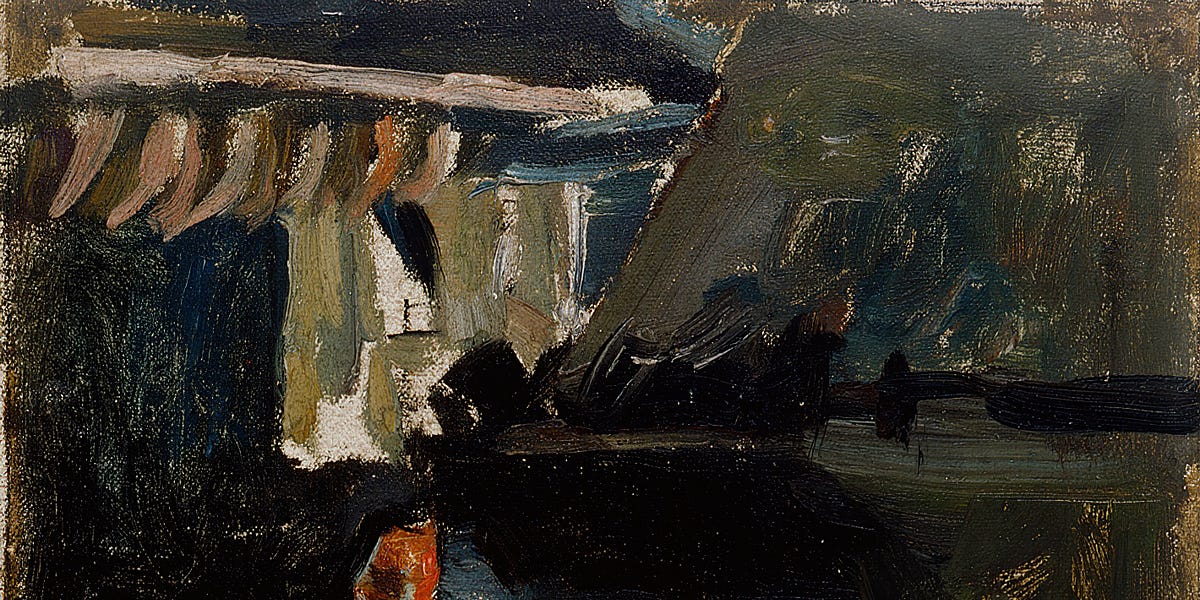
Daily, I would ride my bike for miles into the deep woods down an abandoned railroad grade, explore the mossy ruins of a vast lumber mill or walk to the river that ran at the foot of our property, where I would take a little flat-bottomed boat out upon the water. I fished there, and wrote many pages of terrible poetry, and taught myself to play a sunburst Epiphone guitar, and thought my thoughts—and they were deep thoughts—and, in my way, made peace with it all. I watched and I waited
The great national epic of Finland is The Kalevala, a collection of ancient folk poetry first published in 1835 by the medical doctor and writer Elias Lönnrot from materials compiled among poetry singers living near the White Sea. The beginning portions poetically recount the early life and adventures of the great bard Väinämöinen. Väinämöinen, who had lain in his mother Air-daughter’s womb for “thirty summers” (poor woman), is finally born. He stumbles around for eight years, tripping awkwardly into the ocean and generally just sort of gawking at his surroundings. Then, when he finally really looks up, seeing the sun and the moon and the constellation of the Great Bear, he seems to get his bearings, and goes to live on the island with no words on the mainland with no trees. On that island with no words, Väinämöinen learns about life; begins to understand things. Before
Every culture has its own stories of someone who grew up distant from reality but knows the land very well?But there, in the sheer emptiness of it all, stuff clicks. Soon we find him in the glades (for trees have sprung up in the treeless land because of his growing insight), and he is singing his tales singing, practicing his craft. He sang day by day night by night he recited
Silence is the blank page, blank after you have stared at it for hours. It is the mainland with no trees (impossible and inhospitable). It is the island with no words. I do not mean the pleasantness of quiet, where you go as you like and leave as you like, and which is a privileged vacation from hustle
Blank after you have stared at it. But what if the page is full of connectionsWe wish to believe that the source of our creative power is activity rather than inactivity. We wish to believe that we have in ourselves everything we need to do our work, and that it will be our great efforts that haul that work out of us. And yet what brings Väinämöinen, the bard of bards, into the fullness of his power is precisely that condition of emptiness that so disgusts or unsettles us. It is being in the boring-place, the empty-place, the still-place that something happens to him, something so vast that nature itself unlocks her most intimate secrets
He plays with slanting rhymes and the beat of words, discovers the magic of language. Because of the emptiness, both days and nights are given to the bard. And the final result? Not only mere creation, or that kind of pseudo-creativity which those who only know the superficial silences may practice. No, Väinämöinen remembers.
Held in that memory is the nature of things, the names of reality. Held in that memory is all beauty, for beauty is nothing without truth, and all truth, for truth is nothing without knowing, and all knowing, for knowing is nothing without love, and all love, for the bard has lingered in love, has encountered the source and possibility of love in the sheer nothingness of the island with no words