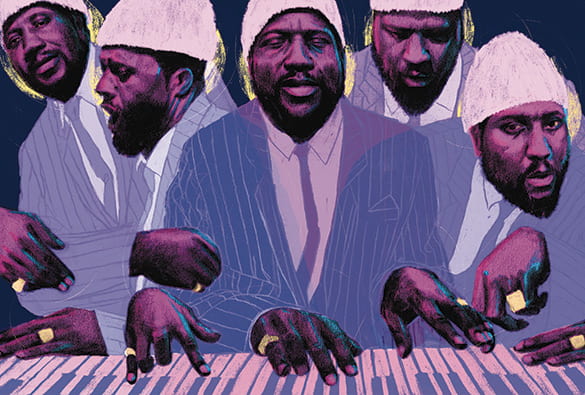
And I thought of Monk’s music. I wondered if his melodic approach to jazz might say something to the multidimensionality of my experiences here and there. What might it say to the rhythms of my existence in the immediate contrasts and juxtapositions of these spaces and places we all experience? Indeed, what does it mean, theologically speaking, to hear its musicality and dance in such spaces?
Our engagement with melody and rhythm has a lot to do with the margins. The way that things relate to each other has less to do with our consumption of them and more to do with how we riff on their base melody, driven by the rhythm that we sense between them. But that never is measuredIn fact, the claim about the “American dream” itself, when juxtaposed with such locatedness, sets in relief the important insight of Charles H. Long, the historian of religions, who argued that “America is a hermeneutical situation.”4 Moreover, having already keyed my theological efforts to thinkers like Karl Barth, the grand Swiss theologian, James Cone, the father of Black Theology, and Toni Morrison, that brilliant novelist and essayist, I knew I needed a medium with a strong enough symbolic center to gather and enhance the aesthetic contributions I now draw from such ancestors. I needed something that could give me order, and I discovered Monk’s music.