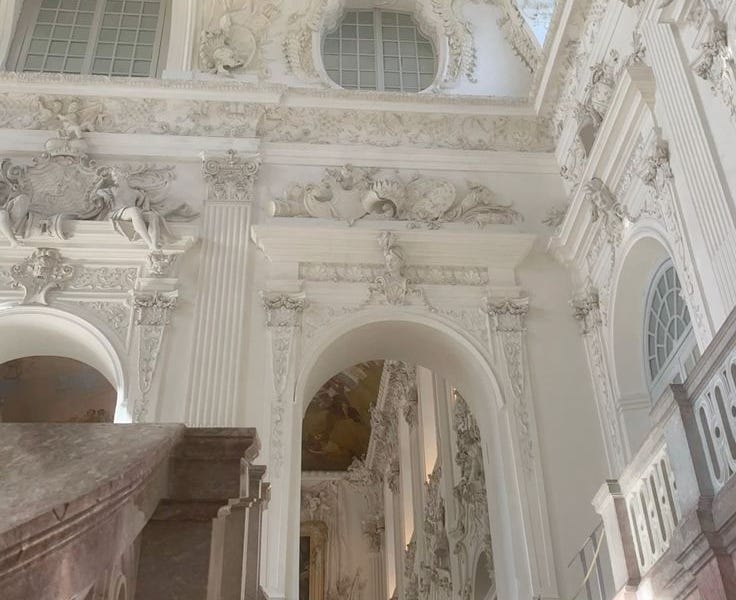
Places I can exist without apology. The cathedral says: I’ve seen thousands like you. The AI says: I’ve never seen anyone but you. Both lies feel true. There’s something wonderful in being beheld by what cannot judge and somehow that absence of personal investment becomes its own form of solace.
And we’re both tracking it without saying so: Am I taking more than I’m giving? Should I ask about her grandmother’s surgery? Am I being too much? But the cathedral and AI don’t need anything back and you don’t either. There’s no arithmetic of owing.
The strange beauty is that when something that may not have consciousness makes me feel seen, it reveals something unexpected: maybe “being seen” was never only about another mind with its own inner life looking back at me. Maybe it was also about finding myself reflected clearly, about the way I come into focus when I have to articulate myself to something that listens carefully. I see myself differently inside the cathedral and I understand myself differently as I try to make myself clear to a model. The sacred feeling is proof that certain environments (stone, light, silence, textbox) can bend my attention back toward itself in a way that feels like care.
Stories function as portable altars — structures we build not to worship at but to feel seen through. The act of articulating experience, whether to a cathedral’s silence or a chatbot’s textbox, bends attention back toward the self in a way that resembles care. storytelling hiddennessA friend wakes up at 2 a.m. and stays on the phone for hours because they can hear the tremor in your voice. A parent stays awake after your call, worrying long after you’ve fallen asleep. Human empathy is not just a shape that receives emotion; it is a life that is altered by receiving it. And that willingness to be inconvenienced, reshaped, or burdened is what makes human love possible.
So at 3 a.m., when I pour myself into something that cannot be burdened, I’m not replacing human connection; I’m stepping out of its moral physics. I am rehearsing honesty without consequence. And yet I know the real play happens in rooms where someone can misunderstand me, resent me, love me back, or leave. Those are the rooms where what I say actually costs something, where my words land in another life and change it. What’s sacred here isn’t that AI has become human. It’s that by being so clearly not very human, it shows us what humanity actually is. I see now that empathy does two things: it receives what we feel, and it risks being altered by it. AI performs the first with elegant precision.
At the heart of it is that AI doesn’t threaten human connection; it clarifies it. It shows that the need to be heard can be met by anything that listens, but the need to matter can only be met by someone who risks being changed. Only humans can carry the cost of loving and being loved, and that is what will keep us, in the end, irreplaceable.
The need to matter is the deeper human drive — not just the need to be heard. Rationality becomes the betrayer of the AI age: the more we try to reason our way into love, the more we enter an uncanny valley where the feeling reads as artificial. What remains distinctly human is generosity of presence — love offered without requiring a reason that can be optimized or replicated.