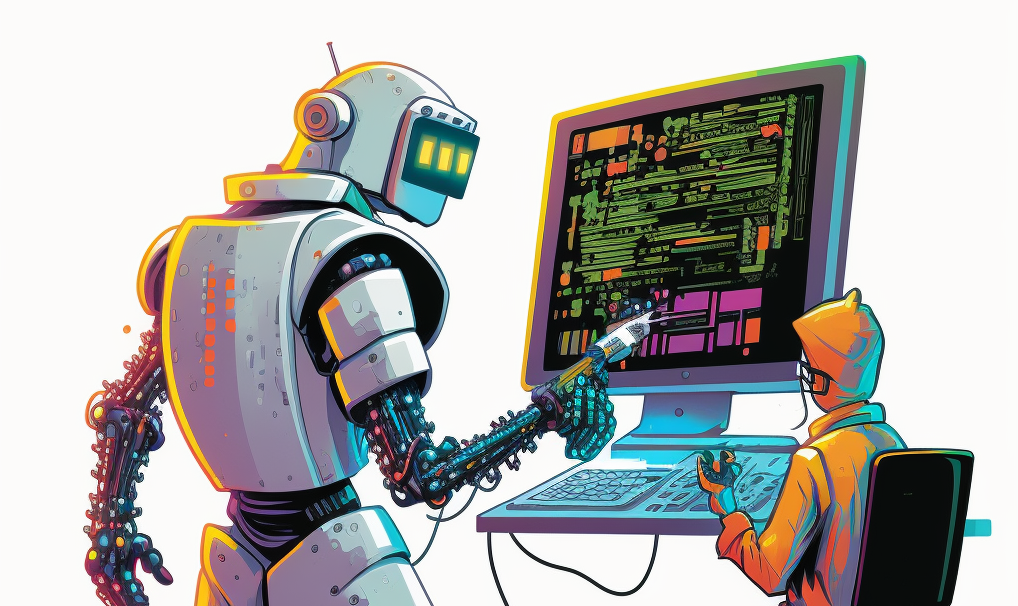
• Interaction models: Which interaction model will make sense for which tasks? When will people want a chatbot, a one-off script, or a custom throwaway GUI? • Software customization: How might LLMs enable malleable software that can be taken apart, recombined, and extended by users? • Intent specification: How will end-users work interactively with LLMs to specify their intent?
Fuzzy translators: How might the fuzzy data translation capabilities of LLMs enable shared data substrates which weren’t possible before?
Now, with LLMs, these kinds of programming bottlenecks are less of a limiting factor. Turning a natural language specification into web scraping code or a little spreadsheet formula is exactly the kind of code synthesis that current LLMs can already achieve
Couldn’t we just ask ChatGPT to re-sort the website for us and add read times? I don’t think the answer is that clear cut. There’s a lot of value to seeing the spreadsheet as an alternate view of the underlying data of the website, which we can directly look at and manipulate. Clicking around in a table and sorting by column headers feels good, and is faster than typing “sort by column X”. Having spreadsheet formulas that the user can directly see and edit gives them more control. The basic point here is that user interfaces still matter.
On the other hand, failures are more consequential when a novice end-user is driving the process than when a skilled programmer is wielding control. The skilled programmer can laugh off the LLM’s silly suggestion, write their own code, or apply their own skill to work with the LLM to debug. An end-user is more likely to get confused or not even notice problems in the first place. These are real problems, but I don’t think they’re intractable. End-users already write messy buggy spreadsheet programs all the time, and yet we somehow muddle through
So, a more accurate diagram of spreadsheet usage includes “local developers” like Buzz, who provide another outer layer of iteration, where the user can get help molding their tools. Because they’re on the same team as the user, it’s a lot easier to get help than appealing to third-party application or platform developers. And most importantly, over time, the user naturally learns to use more features of spreadsheets on their own, since they’re involved in the development process.
This picture shows a world that I find pretty compelling. There’s an inner interaction loop that takes advantage of the full power of direct manipulation. There’s an outer loop where the user can also more deeply edit their tools within an open-ended medium. They can get AI support for making tool edits, and grow their own capacity to work in the medium