Because wild forests like the one on the left were “illegible” to tax authorities, “scientific forestry” transformed them into “orderly strands of the highest-yielding varieties,” Rao writes. “The resulting catastrophes – better recognized these days as the problems of monoculture – were inevitable.” This was the general thrust: over and over, the state tries to impose order (legibility) on chaos (illegibility), disaster ensues. With that context, what’s fascinating about modern Hyperlegibility is that it is not the result of top-down action; we impose it on ourselves. Or Moloch does, at least. Hyperlegibility emerges with game theoretical certainty from each of our desire to win whatever game it is you’re playing. Certainly, it’s a consequence of playing The Great Online Game. In order for the right people and projects to find you, you must make yourself legible to them. To stand out in a sea of people making themselves legible, you must make yourself Hyperlegible: so easy to read and understand you rise to the top.
The “working garden” principle — a space that is productive precisely because it is not optimized for visitors — applies directly to the hyperlegibility trap. As self-legibility becomes effortless, the result is monoculture: everything readable, nothing wild. The superficiality will become visible once legibility is too cheap to signal anything.Hyperlegibility isn’t good or bad. It’s neither and both. But it certainly is. Information used to be the highest form of alpha. Now everyone bends over backwards to leak it.
-
When I say we’re getting better at reading anything, what I mean is that we have both all of humanity’s accumulated information and modern tools by which to discover and decipher new information at our fingertips. Let me give you an example. I was reading Dominion the other day, the book by Tom Holland on the spread of Christianity, and found this paragraph particularly striking:
For almost two and a half millennia, one of the inscriptions commissioned by Darius to justify his rule of the world—written in three distinct languages, and featuring a particularly imperious portrait of the king himself—had been preserved on the side of a mountain by the name of Bisitun. Carved into a cliff some two hundred feet above the road that led from the Iranian plateau to Iraq, its survival had been ensured by its sheer accessibility. The chance to risk life and limb in the cause of deciphering ancient scripts, however, was one that the odd adventurer might positively relish. One such was Henry Rawlinson, a British officer on secondment from India to the Persian court. He first scouted out Bisitun in 1835, scaling the View Highlight 2025-04-16
And let’s say Rawlinson had never scaled Bitisun, that Darius’ words were still undiscovered. How would we get them today? A climb so treacherous as to “do away with any sense of danger”? No of course not. We would send up the drones, equipped with high resolution cameras and maybe some LiDAR, and use photogrammetry and machine learning to stitch the pictures together and make sense of their contents. What once took a decade might take a week, and the results are searchable in a second.
t costs like $100 to read your whole genome. Our telescopes can see 13 billion years into the past. Luke Farritor pulled an ancient library from the ashes of a volcano. Elad Gil is funding efforts to translate “the top 1,000 off-copyright books into all commonly spoken languages,” generate audio versions, and host language models that allow you to talk to and ask questions of each.
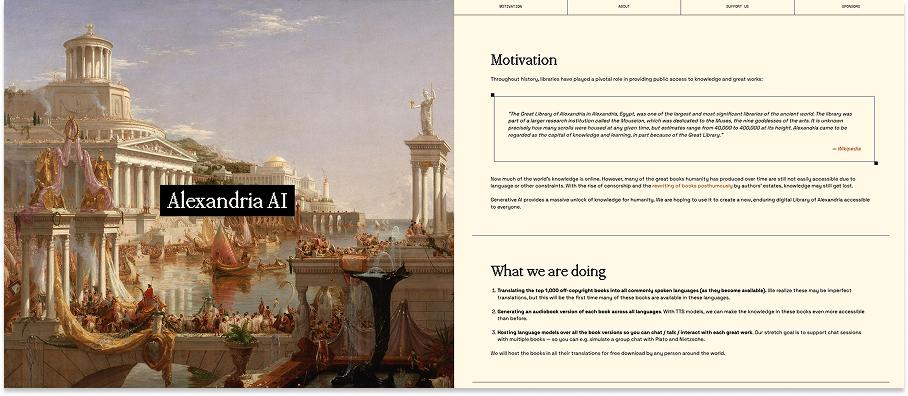 Alexandria AI
Henry Rawlinson smiles. Or weeps. I don’t know. It must all seem so easy and weightless to him.
The point, I hope, is clear. We are getting better at reading the world, just as a book that is entirely illegible to a two-year-old becomes entirely legible to a ten-year-old through improved skill.
Alexandria AI
Henry Rawlinson smiles. Or weeps. I don’t know. It must all seem so easy and weightless to him.
The point, I hope, is clear. We are getting better at reading the world, just as a book that is entirely illegible to a two-year-old becomes entirely legible to a ten-year-old through improved skill.We are game theoretically driven to share more and more of our best ideas, the ones that we might have once exploited in silence.
Curation, editorial judgment, and playlists function as taste made legible — democratizing what was once private discernment. But legible taste also produces an abundance of stories competing for the same attention, which may paradoxically make the illegible (the idiosyncratic, the unexplained) more valuable.Say you convince companies to let you invest early, you need to help them continue to raise money from downstream capital. Which means part of your job is to make quantum legible to the very firms who might one day compete with you. Sure, while your category is small, unproven, weird, and risky, they might let you win at the early stage.
