The Rabbit’s analog feedback paired with the whimsy of mechanical components results in a product that feels more like a retrofuture toy than the literal future. Fitting into your palm with a block-like bezel, Lyu compares the device to a real life Pokédex (where your “rabbits” are the Pokémon)—though it’s impossible to not see Teenage Engineering’s Playdate portable game console in the design, too. advertisement “The fundamental principle is that we’re not trying to replace your phone,” says Lyu. “It’s just a new gadget.” Not replacing your phone meant that Rabbit expects you to carry the R1 and your smartphone of choice. You’ve gotta carry around two things! Lyu isn’t ignoring this problem—he acknowledges it several times on our call—but he also insists that in this stage of AI hardware, he needs to solve for utility first and ergonomics second.
If Rabbit were simply an app, Apple could see his code, which Lyu feels would equate to sharing his company’s IP. He’d need to create and maintain apps for both iOS and Android, which requires lots of ongoing investment for a high level of execution. And ultimately, Rabbit would be served up in the same trough of every other app. “Yes, you can be very successful on the App Store, but you have that lack of sense of security,” says Lyu. “Like, what if tomorrow, there’s a better app? Think of filter apps for Instagram. There’s no loyalty whatsoever!” Lyu argues that hardware, despite its expense and challenges to manufacture, and despite its redundancy in our pockets, offers far more defensibility to his business.
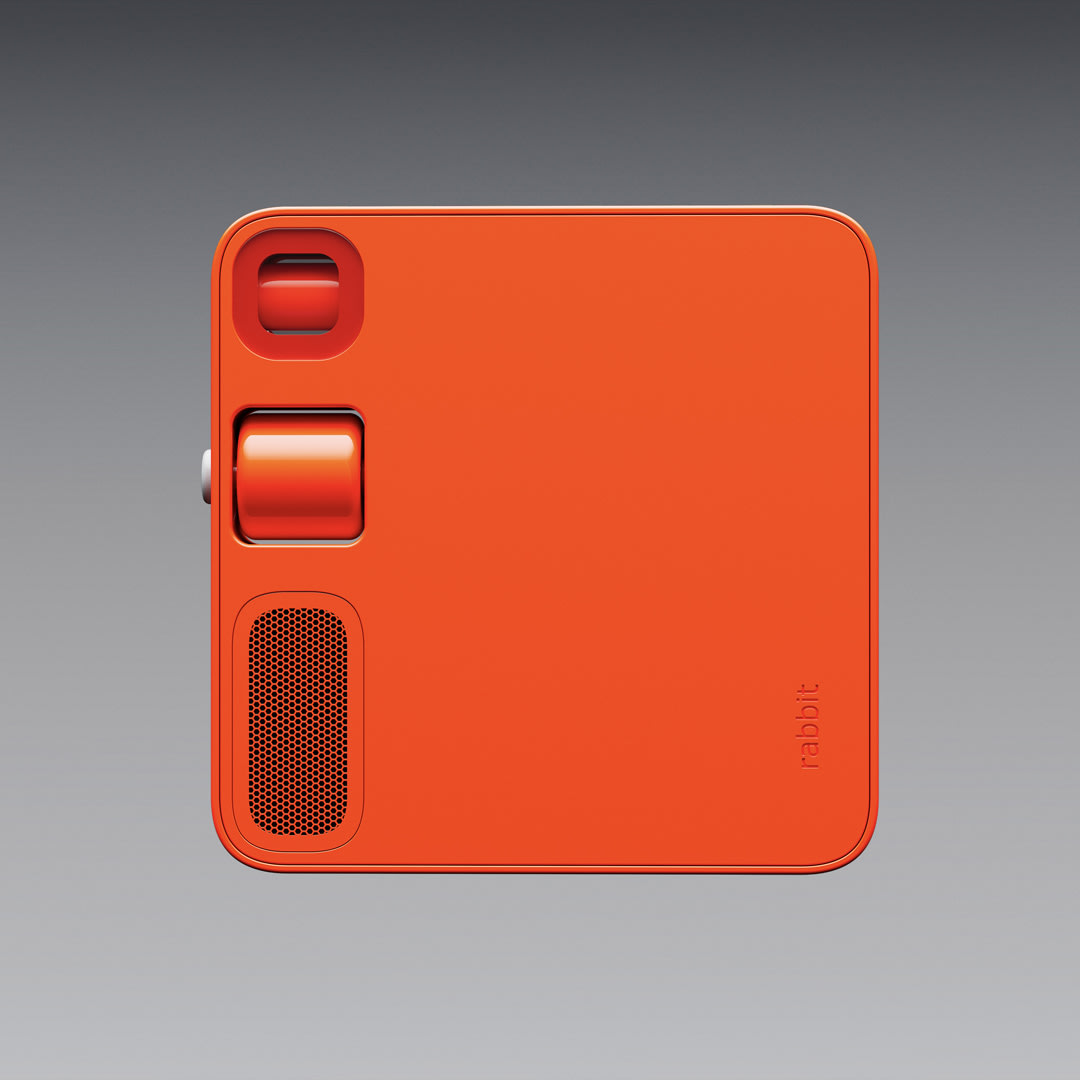 [Photo: Rabbit]
“We knew that the large action model is like [Apple’s] multitouch. It’s so good that we’re gonna protect it to the point that we want to build dedicated hardware just to run it,” he says. “And then the hardware is a result of de-risk. We don’t want to offer you two new things. We want to offer you one thing [AI] and the other thing [an amusing retro-future gadget] that takes you back to the ’90s, the good old fun times.”new ways to be defensible
[Photo: Rabbit]
“We knew that the large action model is like [Apple’s] multitouch. It’s so good that we’re gonna protect it to the point that we want to build dedicated hardware just to run it,” he says. “And then the hardware is a result of de-risk. We don’t want to offer you two new things. We want to offer you one thing [AI] and the other thing [an amusing retro-future gadget] that takes you back to the ’90s, the good old fun times.”new ways to be defensible
