Suno quietly leaves out the part that the process (with its inherent challenges) is often what makes an activity ultimately meaningful and fulfilling. It’s like Suno telling hikers and mountaineers that clambering up a mountain is unpleasant business! Why not take a helicopter to the summit? Meanwhile, Suno is selling helicopter tickets. Statements like Suno’s perfectly captures the prevailing public mindset about AI: that Artificial Intelligence is little more than a labor-saving optimization tool. This mindset tends to be good for
#Capitalism, but betrays not only a lack of understanding of why people make music, but also a profound lack of imagination regarding how we could, or would want to live with our technologies in our lives.I wrote the book Artful Design: Technology in Search of the Sublime as a photo-comic manifesto of why we ought to build tools playfully, artfully, in accordance not only with perceived needs, but also with the invisible values that underly the needs; it probes the question, “how do we want to live with our technologies?”
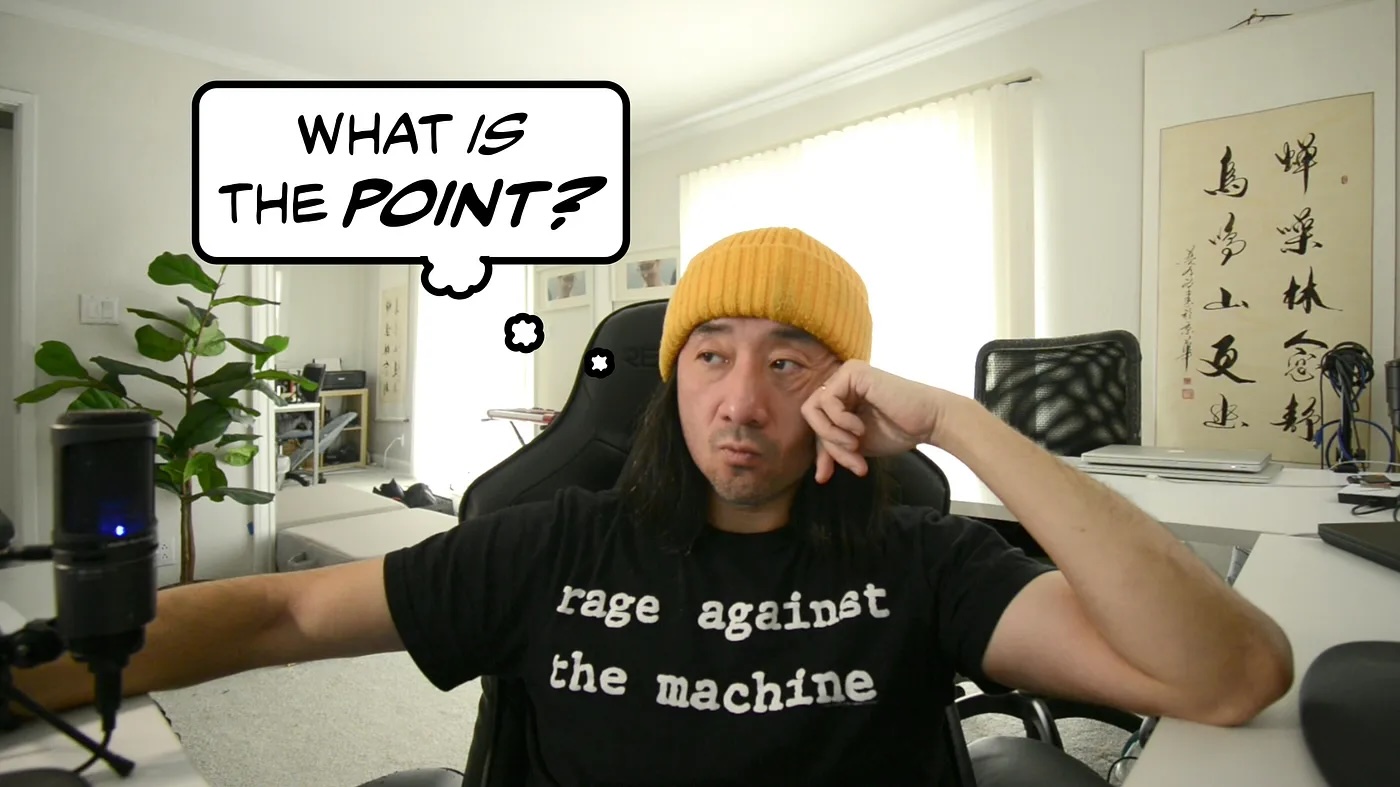
After the performance, I went up to the guitarist and told him so. “Thank you,” he said, “so, what’s your story?” “I am going up to Princeton to start grad school in computer science.” I replied, “I want to build the world’s most advanced automated music composition machine.” The guitarist studied me for a moment and asked, succinct and earnest, “What’s the point?” It was a good question. No, it was a great question; maybe the question.
ask my students to look for interesting questions in everything. I tell them that the power of a good question is not in the answer, but in the question’s capacity to regeneratively invite more questions, and to construct lenses for examining the world — and ourselves. It’s like the question, asked by the ancient Greeks more than two millennia ago, “What is the good life?” We are still asking ourselves this today.
Ruminating on AI and art and the point of it all, I am reminded of a John Cage sentiment: “What we need is a computer that isn’t labor-saving, but which increases the work for us to do.” — John Cage (from “Diary: Audience 1966”)
The technology is new, but what GenAI music companies like Suno are doing is not. Like the recording industry before them (and without whom, ironically, there would be no training data for GenAI), companies like Suno commodify creative expression as part of an aesthetic economy based on passive consumption. Thus it is in Suno’s core interest to usher people away from active creation, and toward a system of frictionless convenience that strives to lower the effort of production — and the effort of imagination beyond vague concepts to type into prompts — to zero. And while no doubt prompting-AI-systems will be a new kind of “muscle” for us all to build, one has to ask: what other muscles will atrophy? There is always a price to pay; the danger of living in a world of frictionless convenience might well be cultural and individual stagnation.
For one, I don’t know what “AI making art” evens means at this point; I barely, if at all, understand “humans making art”. I am inclined to say, therefore, “there should be room for that, too”. At the same time, I am committed to preserving and protecting the room for humans to labor profusely, unenjoyably, illogically to creatively express themselves.
The point is in the mystery, not the aesthetic itself bestill ecology-of-technology