What’s an instinct from childhood that still shows up in your life or work? I have the classic eldest daughter of immigrant parents upbringing: money was something to save, not spend, because you never knew when it might run out. That kind of conditioning doesn’t just go away when your material circumstances change. I’ve been thinking a lot lately about how knowledge doesn’t equal understanding—there are things you can know to be intellectually true, but that doesn’t mean your body or heart has caught up yet. This scarcity mindset around money is one of those things for me. I’m actually really proud of how I’ve moved through my life despite it: relocating to Brooklyn for my art career, leaving my stable tech job, choosing long-term abundance over short-term security. But my internal experience of making these choices is still exhausting. Every financially related decision I make requires this internal override and intense background negotiation with the old voice.
Trust that restless feeling when something doesn’t align, even if you can’t fully articulate why. Be patient with yourself. Finding the right environment, your people, your work takes time, but I promise it’s out there.
One area of growth for me: I have a tendency to overwork things, to keep pushing when I should stop. That mindset can suffocate good art and I’ve lost beautiful pieces because I just couldn’t leave them alone.
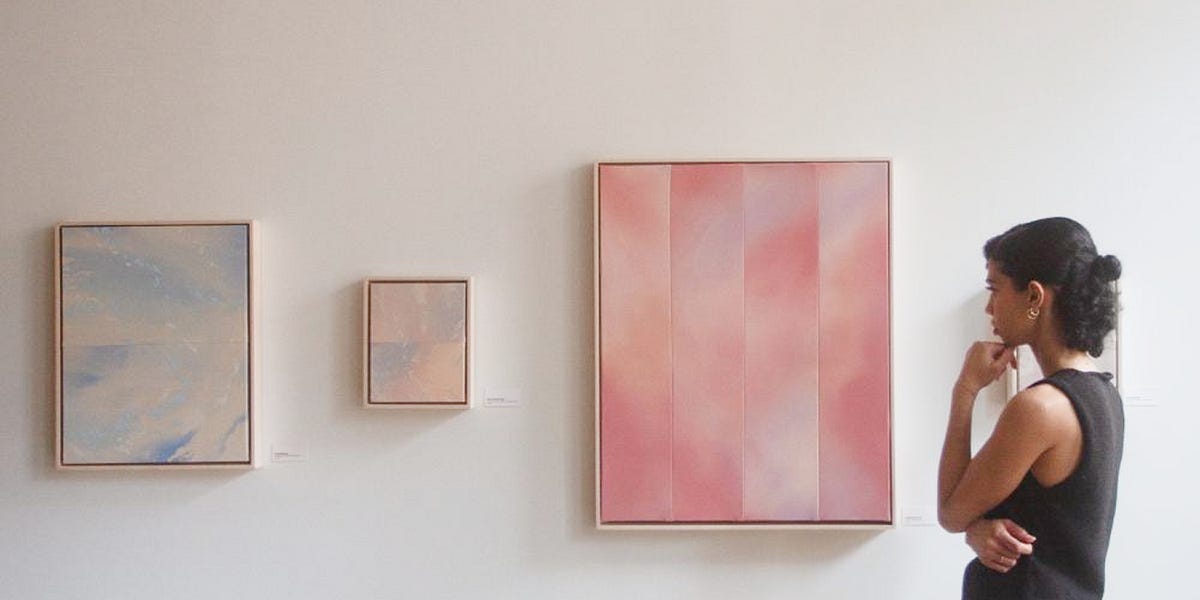
A crucial element of craft is knowing when to stop — leaving work at the point of maximum potential rather than pushing past it. Overworking suffocates the piece; restraint lets the unresolved tension do its own work.What do you want your work to do to someone? I want my work to disarm people and pull them into a state of pure presence. There’s this great quote by George Saunders from his book A Swim in a Pond in the Rain: “We’re always rationally explaining and articulating things. But we’re at our most intelligent in the moment just before we start to explain or articulate. Great art occurs—or doesn’t—in that instant.” That pre-verbal, receptive state is exactly what I’m trying to create through my work. I want my art to be a portal that allows people to access parts of themselves they’ve lost touch with or maybe haven’t even met yet. Abstract art has this beautiful capacity to bypass our analytical mind and intellectual defenses and speak directly to something deeper.
There is a real temptation to chase whatever’s working right now. Yet — One of my fundamental operating beliefs is that you can go the furthest when you stay truest to yourself. There’s a specific exhaustion that comes from constantly shape-shifting to fit what you think people want. I call it type 2 burnout — you’re not overworked, you’re just working against your own grain. Many artists burn out not from the creative work itself, but from the performance of being an artist in the industry.
Where do you draw the line — if you even do — between what is art and what isn’t? As for what separates art from content: content is designed to perform well, while art begins with the artist in conversation with the work itself. The audience discovers that conversation secondhand.
What kind of attention do you want — and what kind do you avoid? Watching someone experience my work (especially in person) and connect with its story is one of the best feelings in the world. This is the kind of attention that feels meaningful.
In general, I think society over-values traditionally masculine traits while undervaluing more canonically feminine, intuitive forms of intelligence. I actually think we might see that shift in our lifetimes because AI can replicate a lot of those logical, systematic processes, and so maybe we’ll learn to value the signs that are less legible but equally, if not more, intelligent.
being able to read other people’s energy or auras, holding contradictory ideas without needing immediate resolution. They just operate on frequencies our current (but limited) systems don’t necessarily know how to fully measure or value yet.
Big Magic by Elizabeth Gilbert is a book I keep coming back to, and one I get more from each time I read it. She offers a very whimsical lens on the creative process that has played an important role in shaping my worldview