Someone exceedingly well-educated and well-positioned who had mastered New Testament Greek once looked me straight in the eye and said: “But Therese, I don’t believe any of this mumbo jumbo.” He never allowed himself to receive or consider or metabolize the words, the content, the meaning, the message. He remained scientific. This is one of the reasons why Dean Samuel Miller commented that “Technique is a way of getting results without engaging the Self.” I understood the nature of our most modern malaise. In music too, it is possible to master the technique needed to play a concerto without having developed one’s humanity in any way.
doctorate is less formative than the broken heart. I’ve been living with Dietrich Bonhoeffer’s The Mystery of Holy Night again, during Advent, and had tears in my eyes to read the single startling sentence: He has loved my worst enemy no less than myself. Doggone it.
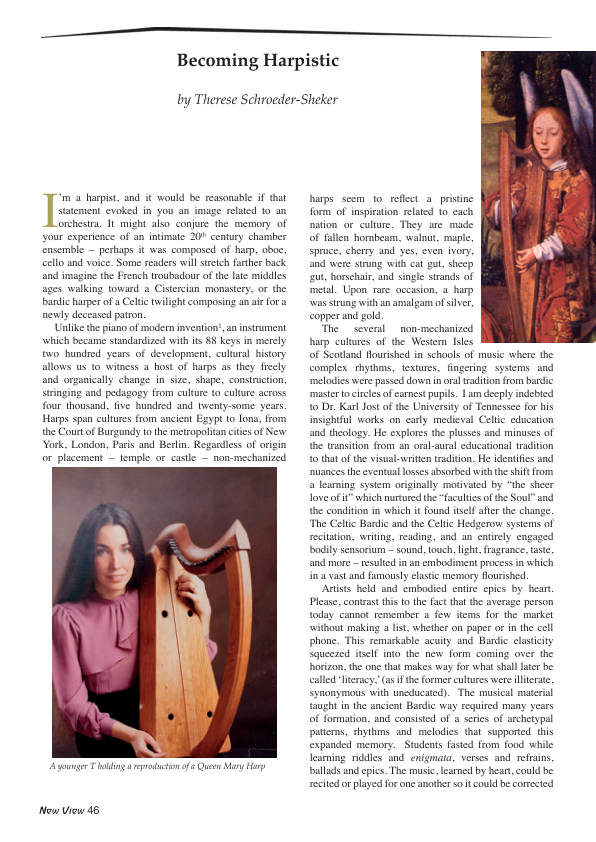
This has everything to do with this possibility I’ve been suggesting about a spirituality of musicianship. The day came when I turned around and looked at the harp and saw that if I paid attention, that life with harp was not unlike living under the same roof with a revered retreat master. It was indeed an instrument for making music audible, but it was also a vehicle for a different kind of awakening: a seeing, imagining, perceiving, listening, hearing, experiencing, encountering tested in endless acts of fine-tuning. The strings of the harp are anchored in the soundboard and then stretched straight up into verticality. The earth-sky axis is visible. For the entire lifetime of a harp, before the pressure of the torque causes it to crack or implode or explode as many do after a hundred years or so, the assignment allotted to a harp is one of maintaining the tension of opposites. The strings are always being pulled in two opposite directions at once, while maintaining verticality, and in fact the stretched strings cannot even create beauty without this tension.
How we meet each affliction and joy, each obstacle and hindrance, each illusion or attachment, each blessing and opportunity – these are the raw materials that make or break the human being and birth the new life, a fuller life. William Wordsworth’s A deep distress hath humanized my soul comes to mind as the jewel in the crown. Sometimes the
I held him, warm hands on his arms, the power of touch, wordlessly letting him know he was not alone, I said his name, tried to breathe deeply for him, and finally, again, a natural responsivity: I began to sing very quietly. This was not a clinical decision. I sang the repertoire I knew and lived and that was entirely embodied and ensouled: the unmetered music of Gregorian chant.
This recollection allows me to return to the urgent timing of a reflection on the nature and meaning of service, of the possibility of a spirituality of music, and of the possibility of admitting something like receiving divine assistance to live a life of meaning. Perhaps the guardian angel is always available, if we are not too professional to admit it. Perhaps we can still be inspired.
. All the teachers and teaching ever needed arrive unbidden, if we allow ourselves to become present to them, resisting the temptation to ignore or push them away. But remember, all the openings, even the most spiritual of openings, descend upon us or arrive at our doorsteps amidst the chaos, noise, mess and slop of the world. Becoming harpistic has helped me learn how not to flee, and instead, how to maintain the tension of opposites needed to live and to serve and to ever-so-quietly inhabit the most beautiful word in the world: Yes!
There is a kind of attention that sees an ordinary moment as an opening rather than a thing to hoard or optimize. What others might dismiss as passivity is actually receptivity — a willingness to be present to what arrives unbidden.